Search The Tattler

Showing posts with label Business Tax Cap. Show all posts

Sunday, February 23, 2025

Council Member Priforce to Force Election on Unfair Small Business Taxes

 Council Member Priforce Says Small Business in Emeryville Is Taxed Unfairly

Snubbed by Council Majority, He Says Voters Should Now Decide

Big Business Pays a Much Lower Tax Rate Than Small Business

Council member Kalimah Priforce announced today he is beginning a campaign to lower the tax rate on small business in Emeryville by forwarding a direct ballot initiative for voters, bypassing the City Council.  If successful, the small business tax ballot initiative would culminate a citizen drive begun in 2011 to finally address Emeryville’s infamous business tax cap, a regressive structure implemented by a pro-business City Council in 1993 that allows the largest corporations in Emeryville to pay a much lower tax rate than small businesses do.  Mr Priforce's announcement comes on the heels of a rejection in December by his colleagues to even discuss the business tax cap at the Council level.  The City Council could get rid of the cap by fiat but they have steadfastly refused and they even actively worked to stop an incipient citizen's ballot initiative in 2011 that would have removed the tax cap.  Emeryville is the only city in Alameda County that has a business tax cap.

Council Member Kalimah Priforce
He says helping small businesses thrive in
Emeryville should be more than just platitudes.
Small businesses in Emeryville should not have
a higher tax rate than big businesses do.

Council member Priforce, who calls himself a 'progressive populist', announced at the Council's December meeting that the lack of equity in Emeryville’s business tax code is troublesome and that the Council needs to finally do something about it especially seeing how they (individual Council members) often publicly exclaim how they want to help small business, he said.  As it is now, the small businesses in Emeryville are effectively subsidizing the big businesses by paying a rate higher than they need to for the City to collect the same amount of money.  A ‘flat tax’, that being every one paying the same rate, would be more fair than the current tax cap scheme and it would enable the City to charge all businesses at a lower rate to collect the same amount of money.  Small businesses would pay considerably less money under a flat tax.

Mr Priforce is correct: Emeryville’s business tax cap is unprecedented.  In fact, no other city in the entire East Bay has such a tax cap.  For small businesses, the business tax rate in Emeryville is .1% of gross receipts.  Large businesses pay a much lower effective rate, and it’s a rate that goes down the bigger the business is.  This is because big businesses, those with revenue that would be taxed above the $450,997 capped total, don’t have to pay any tax at all on any receipts above that.  Small businesses on the other hand, must pay tax on all of their revenue, making for a much higher tax rate; small businesses must pay the full .1%.

Mayor David Mourra
He likes the business tax just as it is.
NO to helping small businesses he says.
He won't even allow a debate about it.

The inequity is highlighted by a comparison between a large business in Emeryville and a typical small business.  A small local restaurant with $500,000 in revenue (gross receipts) owes the City of Emeryville the full .1% of their revenue, whereas Grocery Outlet Corporation owes the City a lower percentage of their revenue.  Every dollar the local restaurant makes is taxable versus Grocery Outlet who doesn’t likely have to pay Emeryville any taxes at all for some of their $3,969,549,003 ($3.96 billion) revenue.  If they were taxed at the rate of small businesses, Grocery Outlet would have to pay Emeryville more than what they now pay with the cap.  The cap affects the two businesses this way: the local restaurant owes the City $500 per year and Grocery Outlet owes no more than $450,997 per year.  The cap being a cap, every other large business in town also owes Emeryville only $450,997 per year regardless of their revenue.  That’s the most any business in Emeryville has to pay, no matter how big they get.  Because Grocery Outlet operates some of their stores as franchises, it is unknown how much of their revenue is taxable by Emeryville and City Hall does not reveal that private information.  

The tax cap is a very sweet deal for the large corporations in Emeryville and something much less than that for the small businesses. 

Council Member Courtney Welch
She says she loves small business.  Except when
it comes to taxing them.  Then she's saving all
her love for big business.
At .1%, Emeryville has the lowest business tax of any neighboring city.  Berkeley’s business tax, dependent on the type of business, ranges from .16% to .45%; from 50% over Emeryville to four and a half times Emeryville’s rate.  And Berkeley doesn’t have a tax cap so every business pays fairly and equally.  With a $12 million deficit this year, if Emeryville raised the rate to what neighboring cities charge and removed the cap, the deficit would be taken care of rapidly. 

Mr Priforce says Emeryville could decide how to best tax businesses after a public debate.  Two ideas are presented without a tax cap: money to the City could remain the same (revenue neutral), meaning a large tax rate reduction for all businesses and a big savings for small businesses, or the rate could be kept at .1%, meaning small businesses would pay the same as they do now but big businesses would pay more, giving the City a lot more money to pay down the deficit and have money left over or something in between.    

City Council Tax Double Cross in 2011

Back in 2011, Emeryville residents reached a boiling point with the tax cap because of the unfair taxation on small businesses.  A drive to put the issue before Emeryville voters was started by Residents United for a Livable Emeryville (RULE), a citizen’s activist group.  RULE took out papers and started a door to door signature drive to get the issue on a ballot because the City Council refused to remove the tax cap by fiat as is their prerogative. After they caught wind of the RULE signature drive, the Council intervened and they unanimously voted YES (in principle) to remove the tax cap on their own and they further announced a petition drive would therefore not be necessary.   That Council vote ended the petition drive but at the last minute, after loud protests from Pixar, the conservative majority on the Council scuttled the deal, keeping the cap in place and leaving the citizens no time to finish their petition drive before the election deadline.  Any new petition drive would have to wait until the next election, two years later.   

After the dirty deal done by the conservative Council majority, stopping the will of the people, Council member Jac Asher offered a consolation: an increase in the tax rate while leaving the tax cap in place.  The conservatives on the Council accepted that and the rate was raised from .08% to the current .1%, still the lowest business tax of any city in Alameda County even with the cap.  Ms Asher’s modest deal and the required two year wait for a new ballot initiative petition drive brought about by the Council majority dirty deal, took the wind out of the sails of the citizen petition drive and it didn't rise up again two years later.

And that’s where we are today.  From then to now, no other City Council member other than Councilman Priforce has publicly offered a plan to get rid of Emeryville’s notorious business tax or even talk about the gross inequities built in to Emeryville's pro-corporate business tax rules.

Councilman Priforce is offering the people of Emeryville a chance to return to 2011; a time when it seemed for a moment, public business tax policy would be decided by the public.  Mr Priforce gave his colleagues on the Council a chance to weigh in on this in December but they refused.  

Mayor Mourra was contacted for this story but he refused to comment, presumably leaving his publicly made NO vote to even allow discussion of changing Emeryville business tax policy, to speak for him.  Council member Priforce was also contacted and he told the Tattler he heard all four of his Council colleagues say NO to his business tax equality discussion proposal and so he will go around them and “listen to the people, not the Council”.   

Please read more on the 2010-2011 fight for a fair business tax HERE, HERE, HERE , HERE , HERE and HERE.

The Tattler will report on developments in this story as they come to light.  

UPDATE CORRECTION:  A reader pointed out that Grocery Outlet operates some of its stores as franchises and so some of their revenue is not taxable by Emeryville.  We thank the reader for catching what we missed and we apologize for the mistake.

A Sampling of Emeryville Businesses & How the Business Tax Cap Effects Them
NOTE UPDATE: Grocery Outlet operates some of its stores as franchises and the franchisees share in some of the profit and those numbers are not public.  Because of this, the numbers in these charts are based solely on the total corporate revenue and are not accurate for Grocery Outlet.  We apologize for the mistake we didn't catch.
Leapfrog Corporation has to pay taxes on every dollar it makes just like the Mom & Pop Shop and the local restaurant.  The big businesses only have to pay taxes up to $450,997 regardless of what they make.  Everything they make over that taxable amount is tax free.  It must be nice for them....says Leapfrog and every small business in town.


A Portrait of Emeryville's Business Tax Cap
Actual Tax Rates For a Sampling of Emeryville Businesses

100 = .1% (the tax rate for small businesses).
NOTE: Grocery Outlet pays Emeryville more than this number because some of its
stores are franchises.  This number is based on their total revenue, not Emeryville receipts which are unknown.
The higher the number in this bar chart, the higher the tax rate.
Higher taxes for small businesses is considered 'fair'
by the Emeryville City Council majority. 
Every other city in Alameda County disagrees with Emeryville.


Wednesday, April 16, 2014

Will Emeryville Join the Rest of the Bay Area? Will Taxes Reflect Our Worth?

How Much Should We Charge Business to Operate in Our Town? 

Should There Be a Rational Basis?

Opinion
The City Council has been looking into raising revenue from lots of different sources recently after Sacramento two years took away the Emeryville Redevelopment Agency, formerly City Hall's main funding source.  Emeryville is left with drastically reduced revenue but the same old list of required maintenance expenditures and discretionary capital improvement projects.  It's caused the Council to think outside the box as far as new revenue is concerned.  What was formerly off limits for this Council majority; making businesses pay more including looking at raising developer impact fees the City charges, is now openly being bandied about.
These public investigations into our revenue streams has laid bare just how low taxes are for Emeryville business.  When it comes to revenue, Emeryville stands alone; business here pays far less than in neighboring cities.  It's the same story across the board: from the hotel occupancy tax to the business tax rate to the real estate transfer tax to impact fees and to outright give-a-ways like the business tax cap which allows the largest corporations in town to pay taxes at a much lower rate than smaller businesses do.  It's sort of a Robbin Hood in reverse thing going on.

"We should charge what 
the market will bare"

Make no mistake, this 'lower by orders of magnitude' taxation culture at City Hall is not an accident, it's not an oversight; it represents the will of this Council majority....at least up until now.
But besides being plain old bad public policy, this low tax thinking has no rational basis.  For rationality to be at play, there needs to be some evidentiary demonstrability in effect.  It needs to be measurable.  But there seems only to be vague and unsubstantiated ideas of the ambiguous benefits of low taxation for business driving the three person majority.  Republican Party folklore about Adam Smith's invisible hand seems to be the animate force guiding this.  The only thing missing are the normally ubiquitous 'trickle down' and 'all boats rising' memes being trotted out.

There's simply no good reason to charge so little.
A rational basis argument for how we can set business taxes in Emeryville would take into account what the prevailing rates are plus the value specifically we represent for business.  Value can be defined in numerous ways like location, access, crime, resident demographics, government services and the local neighborhood desirability in terms of restaurants and parks and the like.  The knee-jerk 'we must keep business taxes low' mantra takes none of this into account.  To set business taxes with these factors accounted for would be to levy taxes based on what the market will bare.  It represents a rational basis that businesses understands.  It's a basis we understand.  To put it simply, we should charge what we can get.  To charge any less is to give a gift of public money to business that's not warranted.

We charge far less than what Oakland charges.  There's something obviously wrong with that.

Another rational basis would be to take into account our 'positives' but charge a little less than what the market will bare.  This argument makes sense if we're trying to pump up the business sector in our town due to some previous deficit.  But it's hard to make this argument in Emeryville, being so laser focused on attracting business as we have been for the last 25 years or so.  The deficit we face can be found in livability, not attracting business.  Among the many metrics, Emeryville is below our neighbors in acres of parkland per resident; far below.  That's a manifestation of a livability deficit.

But what's impossible is to make a rational argument for what the Council majority has been doing until now: giving away the store.  Just watch Council Members Nora Davis and Kurt Brinkman especially.  They arrive at each Council meeting with a barely hidden agenda of 'how can I serve Emeryville business today?'  At almost every turn they devalue the commons to the benefit of business, especially big business. But the loss of funds at City Hall is getting existentially hazardous. The new paradigm of post Redevelopment is something they're clearly struggling with.  When the Council voted to look into raising the transfer tax on March 18, Mr Brinkman almost went out in a blaze of glory; voting NO to even consider allowing Emeryville residents to vote on the idea in November.  But the specter of a 4-1 vote on the Council dais, with Kurt Brinkman standing alone against democracy with this vote as he faces the electorate this fall, brought him back.  Councilwoman Davis to her credit seems to be taking the financial threat at City Hall more seriously; she's been a bit more pragmatic.

However, while we're busy comparing Emeryville's low business tax guiding principles to Adam Smith and what's going on in red states nation wide, we should consider how American worker's dramatic productivity gains over the last 30 years have not been matched in wage gains.  Indeed, wages have been flat or even falling despite labor's prodigious productivity rises.  We're still the wealthiest nation on Earth but the plutocrats have pocketed all the gains....done by design.
It's like what's happened to Emeryville during the same time period; as our desirability here dramatically increases, City Hall is stuck.  We're not benefiting; we can't seem to enjoy anything that we've worked for.  All the gains go to businesses...again, done by design.

It would appear a new majority on the Council is rising up and they're not willing to see the town sink.  They're at least now talking about securing enough revenue to keep us afloat.  So that's encouraging.  But as far as employing a rational basis for determining how to set business taxes in Emeryville, that would require a leopard changing its spots.  Rationality in business tax policy here is going to have to wait.  It's going to have to be imposed by us...at the ballot box...this November.  Kurt Brinkman will be seeking re-election and the idea of raising real estate transfer taxes will also be on the ballot.  We're going to have to make the right decisions amid the coming flurry of propaganda from the Chamber of Commerce.

Tuesday, January 17, 2012

City Falsely Lists Pixar As Major Source Of Revenue

City Punked Again:
City Touts Pixar's Revenue As Animation Giant Outsources Receipts To Burbank

As part of an attempt to gin up support for Emeryville's flagging Redevelopment Agency and carry water for Pixar, the city's e-newsletter website recently listed Pixar as a "major" source of sales tax revenue for the city, however at least one council member asserts Pixar claims that it outsourced its sales and ultimately paid only $8000 in taxes to the city last year.
In the wake of the much ballyhooed looming February 1st dissolution of redevelopment agencies state-wide and the flood of negative publicity about what redevelopment has wrought over the years, Emeryville's City Hall has gone on the offensive trying to seize the narrative that the Redevelopment Agency here has been a great source of good, but the city's claims in its January e-newsletter have run headlong into countervailing public reports about Pixar from council member Kurt Brinkman in an August 2011 interview with the Tattler.
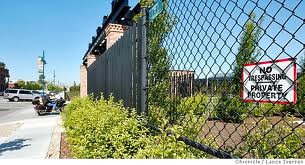
Emeryville gets $8000 
and a security fence.

Emeryville's website features a new page highlighting the record of redevelopment in Emeryville and Pixar is listed as a "major" economic redevelopment project that has produced "dramatic results".  Pixar shares top billing in revenue with six other taxpayer funded redevelopment projects that has contributed $25 million to the General Fund according to the city.

Councilman Brinkman complained in the Tattler interview that Pixar has switched its gross receipts accounting to Burbank California, the headquarters for parent company Walt Disney after the city started talking about removing its controversial business tax cap last year, thereby making Pixar's massive profits out-of-bounds for Emeryville.  Mr Brinkman used the clever accounting move by Pixar as reason to not remove the cap. Council member Brinkman reasons that if the cap is in place then Pixar will be encouraged to accurately report sales in Emeryville and the city will collect more in taxes, an eventuality that has not come to pass.


Editorial:
Emeryville seems to like abuse and
Pixar seems to like giving it.
Maybe Pixar and Emeryville
should get a room.
The cap, unprecedented in the Bay Area, formerly limited the taxes for Pixar and other corporations doing business here at $117,000.  Emeryville voters raised the cap last November to $300,000, but it's not expected to effect Pixar after the outsourcing maneuver.  The cap, even at the new raised level forces small business to pay a much higher rate than the largest businesses.

In addition to outsourcing its gross receipts, Pixar lead a successful campaign to lower its assessed property tax, netting them a $108,000 refund last year.