Search The Tattler

Sunday, October 30, 2016

Election 2016 Candidates Questionnaire: Christian Patz

Christian Patz:
On Livability


The Tattler presents the 2016 election candidates questionnaire.  Candidates for elected office will answer questions broken down into topical sections that effect Emeryville residents. Responses will be released section by section rotating through all the responding candidates representing the City Council and School Board hopefuls.  
The order of presentation was chosen randomly. Regular Tattler stories will be interspersed in the 2016 election questionnaire.  Readers wishing to peruse all the answers by an individual may use the search bar function by entering ”Election 2016 Candidates Questionnaire” with the name of the candidate and all of that candidate’s sections will be presented. Alternatively just typing in the name of the candidate will also work. 
There are six candidates running for three seats and all answered our questionnaire save candidate for City Council Brynnda Collins.  

Today, candidate for City Council Christian Patz answers questions on livability (please check the previously posted section 1 answers for this candidate's bio):

Section 4  Livability

Tattler:  Other cities have implemented bans on ‘formula’ retail; that being national chains, franchises, fast food etc.  Emeryville already has a plethora of these kinds of businesses.  Do you see constituting a ban as something Emeryville should do moving forward?
Christian Patz:  Emeryville needs a balance between large and small retail and local and chain stores. As the onetime home of local Peet’s Coffee, Starbucks is preferred by many residents (I still make my coffee at home). For some small businesses, a franchise business is their local business. This is not something that can be done with a blanket ordinance but needs to be done on an individual basis.


Tattler:  New construction is commonly too expensive for local retail to afford because of the high rents developers must charge to recoup their construction costs.  This is often cited as the reason Emeryville can’t seem to deliver the kind of locally serving retail Emeryville residents want.  The Tattler has proposed new development write off retail rents associated with their residential projects by forcing developers to put in writing their assurances to bring locally serving/non-formula retail.  Would you force this assurance guarantee from developers for new residential development?
Christian Patz:  The city should look into this idea. What have other cities done around this issue? It would be great to see what models have worked and build from there.

Tattler:  Emeryville has gotten worse over time in several key areas, specifically with regards to the things residents tell us they want to see in their town.  We have been told by a generation of City Council members by their voting records that we must accept that Emeryville must get worse over time. The Tattler has made a declaration that we should not permit new development to make our town worse insofar as can be measured.  So for instance in affordability, park acreage per resident, locally serving retail, ratio of home ownership to rentals; these hallmarks of livability (and more) are measurable and the effect new development has on our existing metrics can be measured.  We could have a blanket insistence that all new development not make the town get measurably worse in key areas or even an insistence that new development make our town get measurably better.  Would you support this?
Christian Patz:  This question is too broad, subjective, and leading to answer in a meaningful way. I support not making Emeryville worse. I support affordability, parks, and home ownership, as does everyone running for council.  

Saturday, October 29, 2016

Election 2016 Candidates Questionnaire: Louise Engel

Louise Engel
On Livability


The Tattler presents the 2016 election candidates questionnaire.  Candidates for elected office will answer questions broken down into topical sections that effect Emeryville residents. Responses will be released section by section rotating through all the responding candidates representing the City Council and School Board hopefuls.  
The order of presentation was chosen randomly. Regular Tattler stories will be interspersed in the 2016 election questionnaire.  Readers wishing to peruse all the answers by an individual may use the search bar function by entering ”Election 2016 Candidates Questionnaire” with the name of the candidate and all of that candidate’s sections will be presented. Alternatively just typing in the name of the candidate will also work. 
There are six candidates running for three seats and all answered our questionnaire save candidate for City Council Brynnda Collins.  

Today, candidate for City Council Louise Engel answers questions on livability (please check the previously posted section 1 answers for this candidate's bio):


Section 4  Livability

Readers Note:  Louise Engel did not answer any questions on the livability section.  She did produce the following text as a response to all three questions:

The City staff present to the Council regular progress reports that look at City data that tracks business conditions in the broad sense, for example, through business openings and closures in Emeryville. Our economy, though, does not exist in a vacuum. Our businesses serve local and regional markets. Regional and national economic trends and conditions influence Emeryville’s businesses and economy. City staff join with our neighboring cities to share information to understand East Bay conditions.

A report that looks at regional indicators is one means to understand the economic health of our community. Recently the East Bay Economic Development Alliance released an economic study that includes Emeryville: “East Bay Outlook, 2016-2017.” The report concludes that East Bay cities will continue to experience positive circumstances in 2016. Workers within the high tech and similar categories choose to live here, attracted to Emeryville’s central location and more affordable housing (compared to other parts of the Bay area). This creates short term pressures on small business conditions, housing and quality of life. In the long term, this type of worker category has the potential to provide positive economic outcomes for Emeryville. That labor asset can be leveraged to attract businesses to our city and to foster further growth at firms already located here.

The following are excerpts from the report on pages 5 - 8:
Small Business:
“The East Bay is particularly friendly to small businesses and has a higher concentration of small firms compared with San Francisco and San Jose. Small businesses account for 45.5% of employment in the area, compared with 43.0% in San Francisco and 35.1% in San Jose. These small businesses have been a huge asset to the region during the recovery and current expansion. The distribution of employment in the East Bay indicates that the region is well equipped to support small businesses. It has successfully grown large businesses as well, although it is home to fewer large businesses compared with its neighbors.”
Labor Market:
“The East Bay labor market moved forward at a strong pace in 2015 [2.8%], matching statewide job growth rates and surpassing average national job growth rates. The region also boasted lower unemployment rates in 2015 [4.3%], compared to the state and nation.”
Business Sales:
“As local incomes rise, the East Bay economy also benefits from incrementally higher spending. Taxable sales growth in the East Bay outpaced the South Bay and San Francisco, as well as California. Taxable sales growth in the East Bay also came in faster than nationwide retail sales.”
East Bay Residents as Commuters:
“Outbound commuting among East Bay residents remains most common in high-skilled industries — which means that these workers are likely bringing home relatively higher wages. Many of these workers migrated to the East Bay in search of more affordable housing and improved quality of life while maintaining jobs in San Francisco or San Jose. They now represent a local asset that can be leveraged to attract businesses to the East Bay and to foster further growth at existing firms…. forecasts that payroll employment will continue to grow at roughly 2.0% during 2016.”
Housing pressures short term:
“….the East Bay benefits from these commuters over the short run through increased demand for housing and more spending in the local economy…..Over the longer term, these outbound commuters represent a significant local asset that can be leveraged for a variety of economic development efforts”

[for example] …. that can be leveraged to attract businesses to the East Bay and to foster further growth at existing firms.”


Tattler:  Other cities have implemented bans on ‘formula’ retail; that being national chains, franchises, fast food etc.  Emeryville already has a plethora of these kinds of businesses.  Do you see constituting a ban as something Emeryville should do moving forward?

Louise Engel:  Did not answer the question.


Tattler:  New construction is commonly too expensive for local retail to afford because of the high rents developers must charge to recoup their construction costs.  This is often cited as the reason Emeryville can’t seem to deliver the kind of locally serving retail Emeryville residents want.  The Tattler has proposed new development write off retail rents associated with their residential projects by forcing developers to put in writing their assurances to bring locally serving/non-formula retail.  Would you force this assurance guarantee from developers for new residential development?

Louise Engel:  Did not answer the question.

Tattler:  Emeryville has gotten worse over time in several key areas, specifically with regards to the things residents tell us they want to see in their town.  We have been told by a generation of City Council members by their voting records that we must accept that Emeryville must get worse over time. The Tattler has made a declaration that we should not permit new development to make our town worse insofar as can be measured.  So for instance in affordability, park acreage per resident, locally serving retail, ratio of home ownership to rentals; these hallmarks of livability (and more) are measurable and the effect new development has on our existing metrics can be measured.  We could have a blanket insistence that all new development not make the town get measurably worse in key areas or even an insistence that new development make our town get measurably better.  Would you support this?

Louise Engel:  Did not answer the question.

Wednesday, October 26, 2016

Letter to the Tattler: Ken Bukowski

School Board candidate Ken Bukowski is calling for a special community meeting at ECCL.  


Ken Bukowski cordially invites you to attend the first ever community meeting at the new ECCL. 
Saturday, Oct 29, 2016 at 10:00am - 11:30am     ECCL Building A      Ground Floor     4727 San Pablo Ave    
TOPIC:   Emery Unified School District & School Board Election 
Candidate Ken Bukowski will explain why he is running for the School Board. We will ask participants to complete a survey to learn what issues are important.
We will talk about:
  •  The past history of EUSD
  •   Future financial projections
  •  The city involvement in the ECCL project
  •   Proposal to create a parent advisory board
  •   A plan to hold future community meetings

Other school board candidates (and existing Board members) are invited and will be encouraged to participate.  
This will be the first in a series of community meetings to be held quarterly to discuss school issues with the community solicited to provide ideas and suggestions. 
The meeting will be video recorded to insure all feedback and ideas are not lost. 
Please visit the Emeryville Property Owners youtube channel where you can find all of the school board meetings since 2014 as well as over 2000 videos of past city meetings.

Tuesday, October 25, 2016

Election 2016 Candidates Questionnaire: John Van Geffen


John Van Geffen:
On Livability


The Tattler presents the 2016 election candidates questionnaire.  Candidates for elected office will answer questions broken down into topical sections that effect Emeryville residents. Responses will be released section by section rotating through all the responding candidates representing the City Council and School Board hopefuls.  
The order of presentation was chosen randomly. Regular Tattler stories will be interspersed in the 2016 election questionnaire.  Readers wishing to peruse all the answers by an individual may use the search bar function by entering ”Election 2016 Candidates Questionnaire” with the name of the candidate and all of that candidate’s sections will be presented. Alternatively just typing in the name of the candidate will also work. 
There are six candidates running for three seats and all answered our questionnaire save candidate for City Council Brynnda Collins.  

Today, candidate for City Council John Van Geffen answers questions on livability (please check the previously posted section 1 answers for this candidate's bio):

Section 4  Livability

Tattler:  Other cities have implemented bans on ‘formula’ retail; that being national chains, franchises, fast food etc.  Emeryville already has a plethora of these kinds of businesses.  Do you see constituting a ban as something Emeryville should do moving forward?
John Van Geffen: I believe the role of local government is to even the playing field to help residents and local businesses compete, not simply change the rules of the game in the hopes that when the dust settles things will be better (especially considering the large sums of money that the city would have to expend to defend against the resulting lawsuits from industry advocacy groups). 
The most important thing the Emeryville City Council can do to create a unique and vibrant business community is to support, incentivize and promote local small businesses, not try to ban chain stores in the hopes that local businesses will just materialize as a result. 


Tattler:  New construction is commonly too expensive for local retail to afford because of the high rents developers must charge to recoup their construction costs.  This is often cited as the reason Emeryville can’t seem to deliver the kind of locally serving retail Emeryville residents want.  The Tattler has proposed new development write off retail rents associated with their residential projects by forcing developers to put in writing their assurances to bring locally serving/non-formula retail.  Would you force this assurance guarantee from developers for new residential development?
John Van Geffen: Sitting here today, I cannot guarantee how I will vote on a project that does not yet exist and for which I have no information. What I can guarantee is that I will always listen to the recommendations of the Emeryville Planning Commission and seek comment from the entire Emeryville community, especially those individuals who are going to be directly affected by any new development.


Tattler:  Emeryville has gotten worse over time in several key areas, specifically with regards to the things residents tell us they want to see in their town.  We have been told by a generation of City Council members by their voting records that we must accept that Emeryville must get worse over time. The Tattler has made a declaration that we should not permit new development to make our town worse insofar as can be measured.  So for instance in affordability, park acreage per resident, locally serving retail, ratio of home ownership to rentals; these hallmarks of livability (and more) are measurable and the effect new development has on our existing metrics can be measured.  We could have a blanket insistence that all new development not make the town get measurably worse in key areas or even an insistence that new development make our town get measurably better.  Would you support this?
John Van Geffen:  I do not agree with the premise upon which you frame this question--i.e., "that Emeryville continues to get worse and worse over time". The Emeryville of today may not be what you personally wanted, but it is an amazing city with wonderful people and unique local businesses and our city deserves to be supported and promoted as such. 

Sunday, October 23, 2016

New Tattler Feature: The Truth & Reconciliation Project

Coming Soon to the Tattler:
The Emeryville Nora Davis/Ruth Atkin 
Truth and Reconciliation Project

Take a look around you at our town.  They started with a blank slate.  Factories and blue collar businesses had left in droves leaving Emeryville a virtual ghost town when they got here and this is what they built.  Truth and reconciliation is what is needed as they prepare to leave the stage spouting their own crafted narratives because after nearly 30 years of unitary public policy from Councilwoman Nora Davis and 20 years from Councilwoman Ruth Atkin, we need to face the truth about what we've been subjected to before we can come together and move forward.
Watch this space...

Saturday, October 22, 2016

Election 2016 Candidates Questionnaire: John Bauters

John Bauters:
On Livability


The Tattler presents the 2016 election candidates questionnaire.  Candidates for elected office will answer questions broken down into topical sections that effect Emeryville residents. Responses will be released section by section rotating through all the responding candidates representing the City Council and School Board hopefuls.  
The order of presentation was chosen randomly. Regular Tattler stories will be interspersed in the 2016 election questionnaire.  Readers wishing to peruse all the answers by an individual may use the search bar function by entering ”Election 2016 Candidates Questionnaire” with the name of the candidate and all of that candidate’s sections will be presented. Alternatively just typing in the name of the candidate will also work. 
There are six candidates running for three seats and all answered our questionnaire save candidate for City Council Brynnda Collins.  

Today, candidate for City Council John Bauters answers questions on livability (please check the previously posted section 1 answers for this candidate's bio):

Section 4  Livability

Tattler:  Other cities have implemented bans on ‘formula’ retail; that being national chains, franchises, fast food etc.  Emeryville already has a plethora of these kinds of businesses.  Do you see constituting a ban as something Emeryville should do moving forward?

John Bauters: "Banning" things is a negative approach to developing policy. The goal of providing something other than "formula retail" is one I agree with but I would look for ways to incentivize the alternatives instead of instituting a ban. Bans foreclose opportunities for potential partnerships and networking but incentives can often bring curious or entrepreneurial partners to the table. Many prospective contacts might not result in a business relationship but may lead to an introduction to future partners who are a more suitable fit for the goals and vision of the community. I have been pushing for the city to develop a strategy to fund, market and use our Small Business Fund to make incentives possible. I will continue to push for this if elected. 


Tattler:  New construction is commonly too expensive for local retail to afford because of the high rents developers must charge to recoup their construction costs.  This is often cited as the reason Emeryville can’t seem to deliver the kind of locally serving retail Emeryville residents want.  The Tattler has proposed new development write off retail rents associated with their residential projects by forcing developers to put in writing their assurances to bring locally serving/non-formula retail.  Would you force this assurance guarantee from developers for new residential development?

John Bauters:  I am interested in identifying ways to manage commercial rents in order to help make small business viable here in Emeryville. There are a number of ways this could be done without pursuing provisions that may ultimately be difficult to legally enforce against a developer or property owner. Again, I believe in identifying incentives first and foremost and will be examining ways to breathe life into the small business storefronts that sit vacant around town.


Tattler:  Emeryville has gotten worse over time in several key areas, specifically with regards to the things residents tell us they want to see in their town.  We have been told by a generation of City Council members by their voting records that we must accept that Emeryville must get worse over time. The Tattler has made a declaration that we should not permit new development to make our town worse insofar as can be measured.  So for instance in affordability, park acreage per resident, locally serving retail, ratio of home ownership to rentals; these hallmarks of livability (and more) are measurable and the effect new development has on our existing metrics can be measured.  We could have a blanket insistence that all new development not make the town get measurably worse in key areas or even an insistence that new development make our town get measurably better.  Would you support this?

John Bauters:  I support building a more livable community. As discussed above, the best ways to achieve livability is to plan for our future, pursue smart development, engage developers and businesses proactively about our goals for the community and facilitate community engagement at all levels of civic life. I support holistic evaluation of the value that new development would offer. I am committed to pursuing all of these things in good faith in partnership with the community.

Wednesday, October 19, 2016

City Council Sherwin Williams Vote: Emeryville is Better Without Parks

Council Says Emeryville Urgently Needs More Market Rate Housing,

Parks; Not So Much

News Analysis/Opinion

The Emeryville City Council assures us a new paradigm is ready to blossom at City Hall; a new way of thinking that will finally bring glorious parks to the people.  But first we have to develop the Sherwin Williams site.  And so they voted 5-0 NO to park/open space and YES to more market rate housing, enough housing for 1200 new resident renters.

Now that the City Council has approved more housing at the Sherwin Williams site on Tuesday night and rejected the idea that we should build one large park there and after all the sanctimonious proclamations self-releasing them from their responsibility in this case to fulfill their campaign promises to build the parks we need have been strenuously asserted, we have to ask; where and when is Emeryville going to finally build the parks the people want?  It’s a legitimate question and Emeryville residents have a right to know the answer.  The City Council refuses to say so the Tattler will provide the answer herein so residents can stop waiting.
It's not like we have NO parks.
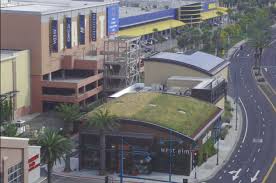
Bay Street mall shows it's appreciation for green.
How about a green roof?  There must be an acre
of luxurious grass up there alone.  

Ever had a picnic up there?

The Sherwin Williams developer will provide a little two acre park associated with the housing project but with more than 1000 people moving into the apartments there, the resultant ratio, more than 500 residents per acre, brings down Emeryville’s park average.  Emeryville goes backwards as far as parks go with this project. 
So the Sherwin Williams site wasn’t the place we were told to deliver the park land the people want.  In an attempt to mollify those who would ask the question, the City Council was quick to remind everyone they share their love of parks and we should trust them they’re going to deliver the parks.  Just not here and not now.

So to the City Council: Just when are we going to see this new park building culture blossom at City Hall?  And where will the new parks be built?
And to the residents: Since they won’t level with us on this, we’re going to have to figure it out on our own.

Parks: How and Where?
Let’s assume we believe the Council’s steadfast yet protean assurances they’ll begin to obey our General Plan’s mandate for 26 acres of new parks within 12 years.  How will it happen?  Developers won't build the parks we need, we know that.  We have a 35 year history of an ever decreasing ratio of park-to-residents average to prove that.  Similarly, our anemic park fees charged to developers won't build the parks we need.  The proof is in that pudding as well- we don’t have enough money to even build one small park this way.  
No, eminent domain is in our future, land seized by eminent domain and paid for with sales from a general obligation municipal bond, however the only land parcels left of any reasonable size in Emeryville already have buildings and businesses on them and after we lost (rejected) the 8 acre golden opportunity provided by the Sherwin Williams site, eminent domain seizure is the only way moving forward.  We know we’re not going to evict people from their homes in order to build parks.  So the only option open to us now is to seize private property and pay fair market value to the owner, pay to relocate the businesses on it, pay to tear down the buildings, pay to clean up the property and then build the park.  That’s what we did to build Doyle/Hollis Park.  That’s what’s going to have to be repeated many times over to get the parks we need.  The business community of course won’t like this idea but we’ll have to disregard their concerns (another new paradigm for our town).
Here's a park for the people.
It's on the second floor of a Wareham Development
project built a few years ago.
It's on private property but it's open to the
public as part of a deal negotiated by the City
(always looking out after our needs, right?).
Ever thrown a frisbee in this park?

Here's The Rub
But this unavoidable eventuality, Emeryville’s future park building schema (by use of eminent domain) begs the obvious question: why not build more housing on the land we clear?  As soon as the land is cleared, developers will want to build more apartment complexes on it and then what’s to stop the City of Emeryville agreeing with the maxim that we need to build more housing to ameliorate the terrible condition of unaffordable housing in our town?  After what we witnessed at Sherwin Williams, we know the City Council can be counted on to make that argument.  Once again it will inevitably rise to the level of a near emergency.  Of course it needs not be said that this is exactly where we find ourselves right now with the Sherwin Williams site... and we see how that turned out (parks be damned).  
So what mechanism would intervene, what could cause new thinking to rise up to cause the Emeryville City Council to suddenly realize our General Plan has value and enable them to say NO to a developer seeking profit in our town?  We have not ever seen that and the new Council members have shown us they aren’t interested in this kind of change.  So what would cause this to happen and, identifying the cause, why didn’t it work at the fallow Sherwin Williams site, a much cheaper site on which to build a park?

News Flash: Emeryville You Won't Get the Parks You Want
After the Sherwin Williams decision, we're left asking why indeed.  The answer to that of course is there is no answer.  There is no city planning that happens in Emeryville.  City planning would mean saying NO to a profit seeking developer with plans of his own.  There is no mechanism to build parks moving forward here, real or imagined.  So don't you believe it when you hear some shit talking Council member or Council member wanna be unload.  There is only the developer’s pain and the City of Emeryville’s bottomless well of empathy, their endless capacity to feel that pain.  Saying Emeryville will get parks like other towns have is like saying America is post racial; it’s what some of us would like to imagine us to be.  We cry foul....Wake up America, you are racist to the core.  Wake up Emeryville.  

City Council Votes For Fair Workweek, No Exceptions

Landmark Labor Law Adds to Emeryville's Progressive Minimum Wage Ordinance

Last night the Emeryville City Council voted unanimously to pass a 'Fair Workweek' policy that will help low-wage workers in the city by providing for predictable work schedules and new requirements for employers to give preference to existing part time workers taking on extra work before hiring new employees and other benefits.  The new law is to take effect in July 2017 and will add relief for Emeryville workers primarily in the fast food restaurant and chain retail industry.   Social equity groups and labor organization backers of the new law called the Fair Workweek provisions passed last night at the regularly scheduled City Council meeting, the "critical second step" added to last year's highest in the nation Minimum Wage Ordinance to build equity in a town with lots of fast food and national retail chains.
Emeryville workers joined social justice activists and clergy
for a pre-meeting pep rally on the steps of City Hall. 

Emeryville already has the highest minimum wage in the country at $14.44 with a path to $16, and with this complimentary new policy, our town stands to become one of the most progressive cities in the Bay Area to address income inequality and the crisis of underemployment.  The new policy will confront and seek to rectify the epidemic of low-wage part-time work while also addressing the problem of unpredictable hours workers face.

“This policy costs employers virtually nothing and does something very simple: provide working people with reliable, predictable hours,” said Jennifer Lin, Deputy Director of the East Bay Alliance for a Sustainable Economy. “Workers will now be able to budget and be able to plan for childcare, second jobs, education, and even rest.”

With Tuesday night's vote, the Council sends a strong pro-labor message to those corporate entities doing business in Emeryville in the form of a strong policy without the usual loopholes, making large corporate retail chains and fast food companies provide schedules two weeks in advance so workers can budget and plan their lives.  Workers will be compensated for last minute changes in schedules. When more hours are available, current workers would get priority so they can get closer to full-time work.

The policy is the first in the East Bay and third in the country following San Francisco and Seattle. 
Earlier this year, a coalition supporting workers issues and social equity issues unveiled a study co-authored by the Alliance of Californians for Community Empowerment (ACCE), Center for Popular Democracy (CPD) and the East Bay Alliance for a Sustainable Economy (EBASE). It revealed that 68% of workers are only receiving part-time hours; 2/3 want more hours; and a staggering 80% have hours that fluctuate from week to week.  
EBASE helped craft language in the new law that some Council members have intoned will help offset decades of accommodation of business interests at the expense of workers by City Hall.

Tuesday, October 18, 2016

Fair Workweek to be Decided by City Council Tonight

Press release from a coalition of coalition of social justice activist groups EBASE,  ACCE, CPD & Fair Workweek.org:

Emeryville Lawmakers to Vote on Fair Workweek Policy
If passed, the policy would take the next step to help low-wage workers, address income inequality, and reshape part-time work

Emeryville, CA – Emeryville’s city council will vote on whether to take the next step in addressing income inequality and the crisis of underemployment by passing a Fair Work Week policy. Though the city has the highest minimum wage in the country, and Emeryville’s low-wage workers are now making $14.44 with a path to $16, there is an epidemic of part-time work with unpredictable hours in the retail and fast food industries.

A coalition of low-wage workers, Emeryville residents, community and labor organizations, faith leaders, and research academics will gather for a press conference before the city council vote. They will press for a strong policy without loopholes. The policy would force large companies like IKEA, Home Depot, and the Gap to provide consistent, stable work hours to allow their employees to budget. Workers would also get schedules two weeks in advance so they can plan childcare, second jobs, family time, and even rest. Finally, when more hours are available, current workers would get priority so they can get closer to full-time work.

Earlier this year, the coalition unveiled a study co-authored by the Alliance of Californians for Community Empowerment (ACCE), Center for Popular Democracy (CPD) and the East Bay Alliance for a Sustainable Economy (EBASE). It revealed that 68% of workers are only receiving part-time hours; 2/3 want more hours; and a staggering 80% have hours that fluctuate from week to week.

The policy would be first in the East Bay and third in the country following San Francisco and Seattle.

What: Press Conference followed by city council vote on fair workweek
Date: Tuesday, October 18th
Time: 6:30pm press conference, 7:15 start of city council meeting
Where: Emeryville City Hall, 1333 Park Ave, Emeryville, CA
Who: Emeryville workers, residents, community and labor groups, faith leaders, and research academics

While the city council has been supportive, the final policy may be eroded with loopholes as developers and corporate retail chain lobbyists pressure council. However, in a published oped in the San Francisco Chronicle, Emeryville Mayor Dianne Martinez and Councilmember Ruth Atkin said, “Now that we’ve won a $15 minimum wage across California, we know we need to finish the job and ensure working people have hours they can count on. A regional fair workweek provides hardworking people with the opportunity to work with stable schedules so they can pay the bills, live healthier lives, and contribute more to our communities.”

Emeryville’s workers are expected to turn out to testify at the council meeting on their experience. “When I didn’t have a regular schedule, my supervisor would put me down for only 16 hours and then schedule me last minute. I had to scramble to find childcare for my baby, and I sometimes worked six days a week and didn’t see him,” said Moriah Larkins, an Emeryville worker who has been in retail for five years. “But now I work for a different company, have regular hours, can spend time with my son, and finish my nursing degree.”

###

The Alliance of Californians for Community Empowerment (ACCE) Action is a grassroots, member-led, statewide community organization working with more than 10,000 members across California. ACCE is dedicated to raising the voices of everyday Californians, neighborhood by neighborhood, to fight for the policies and programs we need to improve our communities and create a brighter future.

The East Bay Alliance for a Sustainable Economy (EBASE) advances economic, racial, and social justice by building a just economy in the East Bay based on good jobs and healthy communities. We address the root causes of economic injustice by developing strategic alliances among community, labor, and people of faith to build power and create change with low-income workers and communities of color.

The Center for Popular Democracy promotes equity, opportunity, and a dynamic democracy in partnership with innovative base-building organizations, organizing networks and alliances, and progressive unions across the country. CPD builds the strength and capacity of democratic organizations to envision and advance a pro-worker, pro-immigrant, racial justice agenda.

The Fair Workweek Initiative, anchored by the Center for Popular Democracy and CPD Action, is driving the growing momentum to restore a workweek that enables working families to thrive.

Monday, October 17, 2016

Major Housing Pivot for Emeryville: Mixed Income Out, Poor Door In


Sherwin Williams Project: ‘Poor Door’ Housing Comes to Emeryville

What’s Old is New Again in Urban Housing Policy: Separate Entrances for Poor People

News Analysis
The City of Emeryville is poised to violate its own mixed income housing policy guidelines to begin a new era of housing segregation based on income if the City Council follows through with the Sherwin Williams development plan Tuesday that would allow the developer of the apartment project to corral all the poor people renting there into a separate building containing only the required below market rate (BMR) rental units.  The move, the first overt separating based on income of Emeryville residents in modern history will put Emeryville in the middle of a nation-wide debate on the increasing use of the so called 'poor door'; the use of separate entrances (or buildings) for poor people by developers forced to include below market rate housing in their projects while attempting to keep the poor people out of sight of the rich people in their projects.
The wealthy in New York City pay a premium for
housing with poor doors but
Mayor, Bill de Blasio has called on a
poor door ban.

The debate about the use of poor doors has generally elicited the ire of city planners and social critics and notably some cities who have banned them outright or are in the process of doing so but also some defenders, a list that now is to include the City of Emeryville.  
The societal benefits of mixed income living have been settled city planning for generations and poor doors have been shown to be not only alienating for the poor but for the wealthy as well. The Urban Institute, a Washington DC based social policy think tank has railed against poor doors' tendency to increase social inequities, observing,  “Elements of building design, such as lack of common areas or shared building entrances, can serve to limit informal interactions, which otherwise could serve as the basis for developing more significant ties.”

As America slides into income and wealth inequality not seen since the Gilded Age, the stratification of society can’t help but be reflected in how a city develops in the physical sense regardless of how egalitarian a municipality imagines or less, claims itself to be.  The return of the ‘poor door’ not seen since the robber baron era resplendent as it was with its separate entrances for servants but now cropping up in new residential development in wealthy urban enclaves, was inevitable given the riven plutocratic society we have built.  

To mollify would be critics of the income segregated housing project scheme at the Sherwin Williams site, Lennar Urban, the lead developer says the BMR apartment building will look as nice as the market rate towers in the project and it will be located next to a planned small park space the poor would be allowed to access.  Talk like that was enough to satisfy the City Council when they approved the Environmental Impact Report for the project at the September 6th Council meeting.  Further, Lennar noted that government agencies who's charge it is helping the poor would be assisted if they were all consolidated in one building.  And they would receive added tax incentives from the federal government.

Sociologists may decry the Dickensian undemocratic nature of poor doors but their use, it has been noted, allows developers to make more money based on wealthy people's general aversion to mixing with poor people and keeping the poor out of sight increases the market rate for market rate housing. Kevin Ma, Lennar's point man for the Sherwin Williams project, refused to answer questions about this point.

Some might find this new direction epitomized by the poor door, redolent of a sociopathic and alienating old direction, to be worth debating in our town, especially since it is counter to the City's own housing policy.  But it is a debate that has not happened as the City Council quickly prepares to move Emeryville into a new era of what can only charitably called 'separate but equal' housing.