Search The Tattler

Showing posts with label Sherwin Williams Project. Show all posts

Sunday, April 28, 2024

Promised "Destination Restaurant" Site Sits Empty For Nine Years

 Developer/City Scams Emeryville Citizens 

"Non-Chain Destination Restaurant" Promised for Parc-on-Powell Project Was Never To Be 

5700 Hollis Street
This was going to be a non-chain restaurant 
serving the community.  Instead, for nine years it has been
vacant like so many other Emeryville storefronts.
With promises of a non-chain destination restaurant made to the public from City Hall and a very visible prime central Emeryville location opening directly onto a park, people may wonder why the storefront retail at the ‘Parc on Powell’ project at 5700 Hollis has remained empty since the site was developed as a mixed use project more than nine years ago.  The storefront, over 3000 square feet in size sits below a large apartment block and has been ready for a tenant for almost a decade.  But it remains vacant like so many other empty storefronts in Emeryville, a festering wound on the town’s retail streetscape.  A recent Tattler investigation found there was never any intention to bring a restaurant here despite all the promises from the developer and the City.


A quick check reveals money is the primary reason this has not rented out to any retail tenant.  At $13,000 per month and the encumbrance of a minimum five year lease, so far no retailer feels they can turn a profit at this location at that price.  On top of that, we found out recently the space was built back in 2015 in such a way as to preclude a restaurant, so says Megan Basso of Walnut Creek’s Lockehouse Realty, the retail broker assigned to the address.  Ms Basso has been trying to rent out the space to anybody for years, it’s just that no takers have surfaced she says. 

The storefront sits right on a park, with an outdoor seating
area adjacent to the green.  Perfect for a restaurant.

After publicly made verbal guarantees from Emeryville’s former Planning Director, Charlie Bryant to the whole community that a restaurant would rent out the space, we find out nine years later that was never going to happen.  Plumbing, HVAC and other infrastructure necessary for restaurant use with apartments above, was not designed into the space from the beginning, rendering the space unworkable for restaurant use.

Heading off any opposition from the community for the proposed development back in 2015, the City sweetened the pot by dangling a destination restaurant before the public.  The development proposal sailed through the approval process without substantial community objection.  That might have been the only use of the "restaurant" to the City (and the developer).   

This is the green just off the small plaza fronting the 
would-be restaurant.  Perfect for outdoor dining with kids.
But, protecting the developer, the City lied to us.
Restaurant or not, libertarians among us might wonder why the property owners don’t start lowering the rent until they get any taker; the whole supply and demand thing.  In reality, many if not most apartment tower owners in Emeryville (usually large real estate investment trust corporations) are not interested in renting out their storefront retail spaces and they just write it off as a loss for tax purposes.  It’s the same reason why the Sherwin Williams developer on Sherwin Street  (called ‘The Emery’), Lennar Corporation, hasn’t rented out the retail associated with that property.  After years of promising local neighborhood serving retail at both the Emery and Parc on Powell and after the City of Emeryville refused to get the assurances in writing, now these developers are letting the storefronts sit empty, bringing down the neighborhoods.  

This scenario has repeated itself over and over again over the years in Emeryville.  The only reason why there is retail storefront at each new apartment tower is because the Emeryville Planning Department is forcing the developers to put them in so they can sell the project to the public as a General Plan conforming ‘mixed use’ development.  After that planning box is checked, there’s nobody minding the store (so to speak) and the retail sits empty for decades as the developer takes his tax write off.

Director Bryant has since retired and was unavailable for comment for this story.


Sunday, December 5, 2021

Sherwin Williams Project: Violation of Public Trust on Labor Rights

 City of Emeryville Screws Construction Workers at Sherwin Williams Site

Dirty Double Deal as Workers Paid Substandard Wages in Our Name


News Analysis/Opinion

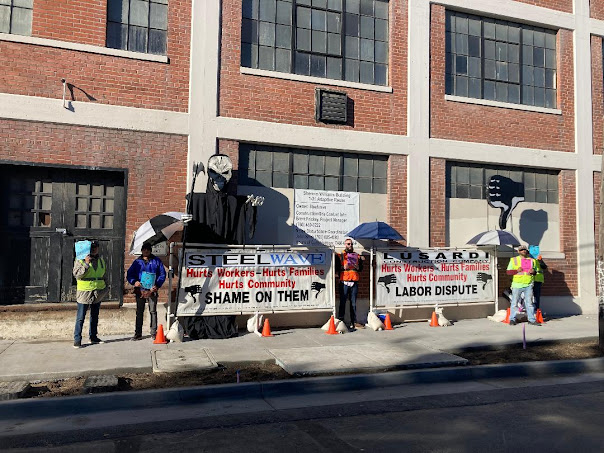
Conspicuous on Horton Street at the Sherwin Williams construction site recently is a large three dimensional representation of veiled black death and a huge thumbs down sign among other signs decrying unfair labor practices.  It's an embarrassment for our town as workers very visibly demonstrate a labor dispute with two sub-contracting firms building the Sherwin Williams project, something the City of Emeryville promised would not happen when this project was approved.  The two  firms, Steelwave Development and Lusardi Construction, have been cited by the demonstrating union workers at the project site over the last few weeks as reneging on the promise that the project be constructed with prevailing union wages that the City of Emeryville had guaranteed. 

The fact that the Sherwin Williams project, the largest construction project in years in Emeryville, is being built in violation of the agreement and so hurting workers in the community is bad for labor of course but the breach of trust violates the City's word as far as the local citizens are concerned too.  The people of Emeryville were promised this project would not be built by oppressing the workers building it.  Had we been told substandard wages would be paid by the subcontractors, we might well have protested this project.  But the City of Emeryville wanted this project to be built and so to get us on board, they assured us this would not happen.  They bought community peace with the assurance the workers would be paid prevailing union wages.  

Now we come to find out it was all a sham by the City of Emeryville.  This Sherwin Williams project is being constructed at the expense of local workers and its being done in our name.  

We admonish the two firms, Steelwave LLC and Lusardi Construction for screwing their workers in our city of course.  But these are profit driven corporations who can be counted on to always do what they think they can get away with as they seek to maximize their profits.  Corporations lie, cheat and steal as far as the law allows; that's to be expected.  So as far as their honor goes, we appeal to them to do the right thing.   But we're not holding our breath they're going to anything but continue to screw their workers as long as they feel they can get away with it.  And they know they can get away with it in a push over pro-development city like Emeryville.

All the parties concerned; Steelwave LLC, Lusardi Construction, the general contractor Lennar Development and Mayor Dianne Martinez as well as the City of Emeryville refused to comment on this.  We expect silence from the contractors but the City of Emeryville has to behave in a transparent manner.   This is public policy.  We want to know what City Hall is going to do about this.

We're calling out the City of Emeryville for this dirty double deal, screwing workers in our name.  We say the City has to make this right.  They made their promise to us, the resident citizens of this town, and now they have to step in and fix this.   


A city that loves developers is willing to screw workers. 
Emeryville promised us this wouldn't happen as long as we supported this project.

Sunday, November 29, 2020

Emeryville Reverses Course on COVID Mask Policy

Public Mask Wearing Order Policy Thrown Over to Private Sector

City Hall Places Public Health Trust With Private Developers 

No More Surprise Inspection Visits From the City

News Analysis

The City of Emeryville has initiated a new COVID policy that claims to punish contractors at construction sites in the city for their workers not wearing masks—but only if they get caught—and they won’t get caught because the City will only check for compliance during regularly scheduled construction inspections.  The contractors will be fined $188 if their workers are not obeying the Alameda County mask order but, absurdly, they know exactly when the City inspectors will be coming to their job sites so workers can quickly slip on their masks during the inspection thus avoiding both the fine and public health policy capacity.  How’s that for effective public health policy during a deadly pandemic?  It’s like if the police gave warning to crack house squatters that they’ll be breaking down the doors next Thursday at noon to look for crack and make arrests.  Think there’ll be any narcotics to be found at the crack house next Thursday? 

This ridiculous situation is where Emeryville City Hall is in the fall of 2020 with COVID-19 raging through the population.  It represents a regulatory relaxing of deterrence against rule breakers.  The new COVID policy replaces former policy from last April when the City didn’t give warnings before they came to check on mask wearing compliance at construction sites in town. 

With Americans’ expectations of general dysfunction or even uselessness from their government the new norm, Emeryville’s new public health policy in the face of an exploding pandemic is notably feckless and reckless.  It is after all the preeminent role of any government to protect the health and welfare of the people.  Maxims aside, the COVID policy we’re getting in Emeryville is inverse to the threat level the deadly virus poses. 

Emeryville City Manager
Christine Daniel

 'Emeryville COVID policy
should be relaxed as the 
virus explodes exponentially.'
When the pandemic first took hold last April, Emeryville formulated an effective response to the Alameda County mask wearing order it is charged with enforcing.  Citizen complaints registered with City Hall against workers seen not wearing masks at any of the construction job sites in town would draw a surprise visit from a City of Emeryville building inspector.  Violators were given warnings at first but the City formulated a program of increasing punishments against wayward building contractors.  This policy has been replaced this fall with a new policy where, after receiving a citizen complaint, the City will not send a surprise visit from a building inspector.  Instead, building inspectors have been directed to notice if any workers are not wearing masks at the job sites during regularly scheduled calls for inspection services.  The calls for inspection it should be noted, come from the contractors themselves.

The City’s first iteration of mask wearing compliance at job sites allowed the contractor to mete out punishment against the workers with promises from at least one contractor to the City that offending workers employees would face employment termination.  A public records request revealed that the contractor at the Sherwin Williams building site on Horton Street had violated the County mask order in late August with a City building inspector recording in his report from his surprise visit he saw “12 individuals without masks on.  Four of these individuals were within 6 feet of another worker.”  No workers were reported terminated for that violation nor were any for violations called in after that initial contact by the City.


A new policy without such surprise visits from City inspectors arose sometime after an early September flurry of violations, primarily at the Sherwin Williams site and with some recorded at the “Intersection” site (AKA the Maz Project) on San Pablo Avenue at Adeline Street.  The new policy was clarified by City Manager Christine Daniel who told the Tattler Wednesday, “The City’s building inspectors continue to remind contractors about the requirements and will cease an inspection if proper [mask wearing] practices are not being followed.” 

The new policy, unsurprisingly, is less effective at catching violators at the job sites.  The employees of the contractors are now all wearing masks having been forewarned when the inspectors are arriving at the sites but subcontractors, who aren’t at the site every day have been problematic as it turns out.  The subcontractors apparently aren’t getting sufficient forewarning from the contractors and are consequently getting caught by City inspectors.

The City has stopped relying on the contractors to terminate offending employees, a relic from the first COVID mask wearing policy and now the punishment leveraged against contractors is that the inspectors will leave a site if any workers are seen not wearing masks.  City Manager Daniel reported to the Tattler on Wednesday,  “As recently as Monday of last week an inspection was terminated, a correction notice issued and the contractor was requested to notify all sub-contractors to review the importance of compliance with the County Health Officer Orders.”  The fee for rescheduling an inspection is $188, an amount so low that it can be easily absorbed as a cost of doing business for any large project in town.

So the new policy from City Hall is not effective according to the City itself.  The former policy had a mechanism to catch violators but lacked effective punishment and the new policy is ineffective with regard to both catching and punishing violators.  The result is worksites without workers wearing masks continuously happening in Emeryville since last April.  

Emeryville is not interested in doing what it takes to satisfy the Alameda County mask order and therefore not interested in helping to stop viral infections, even as cases spiral in our community.  This is not an opinion.  This is demonstrably true, using the City’s own records.  This story is not an editorial or an opinion piece. 

The City Manager failed to explain when and why the City’s new COVID policy was enacted, only that it had been implemented.


$188: Not Much of a Punishment
Letter from the contractor to sub-contractors at 'The Intersection' project.
This violation cost the contractor $188 in a project that will run 
more than $50 million.  The workers don't want to wear masks and neither the
contractor nor the City wants to force them.

Sunday, March 3, 2019

New Development Drives Need For New Parks But Developers Aren't Helping

Clock Ticking on Sunsetting General Plan: 
 22-26 Acres of New Parks Needed
in Ten Years

City Council Letting Developers Off the Hook 
For Providing Needed Parks 

New Development is Reason New Parks Are Needed:
Onni Project Case Study Reveals  
City's Unaccountability

News Analysis
The Proposed 700 Foot Onni Tower Project
1100 new residents but only a 1/2 acre park is planned in trade,
running roughshod over Emeryville's General Plan.

The developer of the proposed Onni Tower, a 54 story residential development on Christie Avenue, has been lately shopping the project before citizens around town, standard fare in the pre-approval state for proposed development in Emeryville.  So far it's been drawing the usual chorus of neighborly concerns over the myriad negative impacts such a large development would bring.  However one overlooked issue with the Onni project, heretofore not in the eye of Emeryville residents, presents itself as a result of the tower's 1100+ new residents that could prove to be impactful not for the residents but instead for the developer.  That issue is parks.

The Onni project developer as it turns out, needs to provide more than three and a half acres of new public park space in town to offset all the new residents and new employees that project will bring- some three acres more than what's being proposed.  That's three and a half acres total of new park land for Emeryville because of this single project if when it comes time for final approval, the City Council is in a mood to enforce Emeryville's General Plan.

Onni Tower Mini Park (Proposed)
At only 1/2 acre, it won't be nearly big 
enough to satisfy the General Plan. An
additional three acres off-site is needed.
Because the site isn't large enough for that much park space, in order to comply with the General Plan, the Onni developer would have to provide the money for Emeryville to build at least three acres of parks elsewhere in town in addition to the half acre park planned for the actual site.  If the City were to build all the off-site Onni generated park space in one location, at three acres, it would be the second largest park in Emeryville, smaller than Marina Park but more than double the size of the next largest Doyle Hollis Park with its one and a quarter acre.
Existing Doyle Hollis Park (1.25 Acres)
The off-site park needed to be built by the Onni developer
 would have to be more than twice as large as this.
And that's not all.  If the City Council grants the Onni developer a full or partial pass on the City's new family housing unit mix regulations as it is considering doing, that would mean more studio and one bedroom apartment units in the 700 foot tower, adding to the population and driving up the acreage of parks needed to offset it.  The amount of extra park acreage that condition would generate is hard to calculate, contingent as it is upon how far the City Council rolls back the regulations for the developer.

Despite its clear mandates, Emeryville's central guiding document, the General Plan and its provisions for parks, are not even being discussed by the developer or the City staff as the Onni project moves forward through the approval process.  It's part of an ongoing case of willful amnesia the City of Emeryville has historically had when it comes to the General Plan's park provisions.


Three Acres Per 1000 Residents
Parks are extremely popular with Emeryville residents.  Polls conducted by City Hall over the years have revealed as much.  Candidates for City Council are all acutely aware of it; regardless of their political leanings, they routinely place the building of more parks front and center in their campaign literature.
Surprisingly though, Emeryville residents are still dramatically under served in parks and open space.  In 2009 when the General Plan was adapted, there were 15 acres of public parks.  Doyle Hollis Park at 61st and Hollis streets was added shortly after bringing Emeryville's total up to about 16 1/2 acres in a city of 10,000 residents.  That works out to an anemic 625 residents per acre, and that doesn't include the daily workforce of 20,000 using the parks, making Emeryville the most park poor of any city in the entire East Bay.
The General Plan, rising to the challenge, recognized the need for more parks and standardized city planning metrics were applied to determine how many acres of parks our town needs.  The nation's premier city planning collegial body, the American Planning Association (APA) provided the justification of a minimum of three acres of parks per 1000 residents or 333 residents per acre and that was adapted in 2009 for all new development in Emeryville.
Also included in our General Plan are provisions recommended that a minimum of one quarter acre of park land is needed to offset each 1000 daily workers.  At the current approximate 20,000 workers city-wide, Emeryville needs to add another five acres.  With a projected 30,000 workers in 2029, the sunset year of the General Plan, the daily workforce offset needed would be seven and a half additional acres of parks.  The Onni project, with its 325,000 square feet of office space plus 20,000 square feet of commercial space at the standard average of 151 workers per square foot translates into one half acre of park space the developer needs to provide to offset.

From the 2009 Emeryville General Plan
We need to build 22-26 acres of new parks to 
get to the goal of 41-46 acres before 2029,
the year the General Plan sunsets.
While Emeryville has added some park land over the last ten years, approximately two acres, that's not been enough to keep pace with our burgeoning population rise, contributing to a downward sliding ratio expressed in our lowest-in-the-East Bay population per acre of park land.  So regardless of the three acres per 1000 residents as the guiding principle spelled out in the parks section of the General Plan, Emeryville is now actually worse off than it was in 2009.  With its current 13,000+ residents, Emeryville has only 17.8 acres of City parks.  That translates to an embarrassing 730 residents per acre for our town and that doesn't include the daily workforce.


Councilman Donahue's Proposal: Nearby Parks
Against this rueful backdrop, Councilman Scott Donahue appears to be doubling down on the City's inaction on parks.  Citing the need for "close by" parks for residents instead of increasing park acreage, Mr Donahue is calling for Emeryville to use a new metric to measure how well the Council is doing on providing parks; namely how many people live within a half mile radius of a park, rejecting the General Plan's three acres per 1000 residents metric.   Conveniently, Councilman Donahue's new way of measuring shows the City as a smashing success on parks and getting better every year since more than 90% of Emeryville residents live within a half mile of a park.
Emeryville's new mayor, Ally Medina, acknowledging the poor record of the City and eschewing Council member Donahue's park proximity metric for measuring the City's park performance, is pledging to do better.  Calling herself the "parks mayor", Ms Medina says the General Plan will no longer be ignored with regard to parks.

Emeryville's 'parks fee' it charges developers has not been up to the task of actually building any parks because the amount City Hall receives doesn't match the costs the City incurs with building parks here.  Adding new parks has become extremely expensive and there has been talk of getting the property owners in town to pay for it by floating a municipal parks bond.  Because almost all the land has buildings on it, the City will have to buy land from reluctant sellers or seize it by eminent domain.  Then the businesses on the site will have to be moved, the land cleared and cleaned up before the actual park can be constructed.
It should be noted the fallow Sherwin Williams site provided the City Council last year an inexpensive way to build a large park but they chose instead to approve development of several large apartment blocks, further exacerbating Emeryville's already bad residents-to-parks ratio.

The costly nature of new park construction and City Hall's limited funds to build them thus serves as a motivator in getting the developers to help pay for the new parks.  Especially because it's the (residential) developer's projects with all their new residents who want and need uncrowded parks that are the reason Emeryville must build more parks. 


From the General Plan:
"As the residential and employment populations increase, it is essential to seize every opportunity to
create additional parks and open space, and to provide public facilities and services that meet the needs of the community."

Sunday, December 9, 2018

City Staff Fails at Sherwin Williams Project to Provide Required Retail Agreement

City Fails to Get Sherwin Williams Retail Agreement in Writing

City Council Comes Up as Empty as 
All the Storefronts in Town

Senior planning staff at City Hall revealed last week the retail component of the Sherwin Williams project mixed use residential development in Emeryville's Park Avenue neighborhood has no written protections that would keep storefronts from sitting perpetually empty despite the City Council expressly garnering a guarantee against that made in 2016.  The Council also directed the staff to protect against the developer renting to chain stores, another condition of approval from November 1st, 2016 that was ignored by the staff and now impossible to enforce.  Time has run out for Emeryville to ensure its retail plan at Sherwin Williams is brought forward; the developer cannot at this point be held to providing for non-formula retail at the site or providing against letting the stores sit empty as was established by unanimous Council vote.  "There are no such protections for either condition" a staff member told the Tattler, "nothing is in writing".
Councilman Scott Donahue
He told voters in October 2014:
"We should require developers to structure
rental agreements that provide for subsidies
and other support to help smaller,
locally serving businesses to succeed."
 

And so goes the Sherwin Williams project down the same path as virtually every other development with retail over the last 25 years; vague promises made by the developers to providing wonderful neighborhood serving non-formula stores in a timely manner, a paradigm that has spectacularly failed.  City Councilman Scott Donahue  summed it up best at the November 1st 2016 meeting, "It has been difficult for our city he said, The chains have more money, but we have a desire for retail expressed by our community, he added.

The loss of a written retail agreement so adamantly expressed by the Council is especially egregious for the Sherwin Williams project, watched so closely as it has been by community activists including by the Park Avenue Resident Committee (PARC).  Indeed, PARC's entire raison d'être is to make sure this kind of thing doesn't happen, specifically at Sherwin Williams.  Emeryville residents would be excused thinking if we can't get a retail agreement that addresses these issues here, we likely can't get one anywhere.

It's been a problem for years here.  Many residential developers in town build associated retail as required by the City but they aren't interested in the commercial rental business and so because the City has never required them to fulfill their retail assurances in writing, the developers simply let the storefronts go empty.  The retail component is chalked up as a cost of doing business by these developers.  Other developers, seeking more traditional profit maximization, will rent their retail spaces out but at the highest rate the rental market will bear.  That generally prices out the kind of retail the residents want, leaving only chain stores.
Amid the exigency of this closed loop paradigm, Councilman Donahue hit upon a new idea to force the developer of Sherwin Williams to underwrite the retail by written agreement with the City, an expanded cost of doing business that actually would deliver, but he and his colleagues failed to follow through, trusting the staff to do as the Council directed.
Councilwoman Dianne Martinez
"Another thing we're hearing from the community 
is the fear of the retail space going empty. 
The landlord might prefer a write-off 
than lowering the rent"
She directed the staff to get it in writing.

The idea that the developers themselves need to underwrite the cost of providing locally serving, non-formula retail has been kicking around in Emeryville for many years but the previous Council saw adding such constraints as anathema to the pro-developer coda engrained at City Hall.  Responding to citizen complaints in 2003, a previous Council attempted to lure better retail instead with a taxpayer subsidy to businesses at the 'Promenade' development, albeit with mixed results.  A coffee shop that received taxpayer subsidies at the San Pablo Avenue Promenade strip mall development promptly went out of business as did a small restaurant but Arizmendi Bakery, also the recipient of start-up help from City Hall has been a success.
The current City Council has so far tried a different approach, attempting to lure the kind of retail the citizens want with a Byzantine system of 'bonus points', an approach that up until now hasn't met with success.  With the failure of the Council to follow up on the staff's directive at Sherwin Williams, the new idea of forcing the developer to underwrite the locally serving retail is an idea that has still not been put into practice in Emeryville.

A viewing of the short video (below) from the November 2016 meeting shows how stark is the recalcitrance of Emeryville's city staff.  The two Council members whom had promised voters to deliver non-formula locally serving retail when they first sought election, Scott Donahue and Dianne Martinez, were adamant.  Councilman Donahue told the staff the developer represented by Kevin Ma of Lenar Development they could lower the rent for the retail if he (Mr Ma) can't find "non-chain neighborhood serving" retail at the market rate and that the rent should go down until it is rented out to the desired tenant.  "We can come up with something simple that they (Lenar) can agree to tonight that would solve this problem and make this a better community." Mr Donahue told the staff.  "I'm all ears to cutting a deal tonight about this" he added.

Emeryville Planning Director Charlie Bryant
Handpicked by former City Councilwoman
Nora Davis, Charlie did not require Lenar to legally
agree to the Council's requirements.  Lenar is free
to leave the Sherwin Williams retail empty
or to rent to Burger King.
Councilwoman Martinez agreed and expressed concern that the retail storefronts not sit empty as so many others have done over the years in Emeryville, "Another thing we're hearing from the community is the fear of the retail space going empty. The landlord might prefer a write-off than lowering the rent"  Ms Martinez said.
The developer however expressed concern that the development process not be held up for anything, "The biggest problem tonight is from a timing standpoint." Mr Ma told the five Council members  'If we would make any amendments to requiring the regulating of the retail tonight, that really throws us off our timeline...  We've gotten to a razor thin timeline with the current approval schedule".  He assured the Council "We will work with the Planning Commission to bring these commitments..." to which Councilman Donahue responded, "I'm satisfied we can say 'no' to your project if you don't come back to us with something definitive in writing that will deliver just what we're talking about."

And then the Emeryville City Council dropped the ball; they never checked on the staff about putting their directives in writing, leaving the citizens with nothing but the same assurances they've always gotten from developers over the last two decades about all the wonderful retail to be coming.  The staff for their part, refused to comment on why they served the developer rather than the City Council they are paid to, "It is what it is" one staffer tersely told the Tattler last week after affirming that the Sherwin Williams developer could rent to any chain store they want to at their project or to not rent out the future retail spaces at all if that serves their pleasure.  It's all up to the developer's whims now.


The November 2016 smoking gun video that 
reveals the Emeryville staff to be recalcitrant.  

Friday, April 6, 2018

Planning Commission Votes to Kill Trees Without Critical Arborist Report

City Hall Staff Withholds Critical Document from Planning Commission 

Healthy Trees Called "Unhealthy" by Staff

Commission Voted to Cut Trees Without Knowledge of Arborist Report

Ten trees fair to good, Two fair to poor = "Unhealthy"


The Emeryville Planning Commission, siding with City Hall's Planning Department staff, PG&E and the developer of the Sherwin Williams project voted unanimously March 15th to overturn the City's Urban Forestry Ordinance and to kill every street tree on Horton Street fronting the incipient apartment project slated to break ground later this year.  The unanimous Planning Commission vote was based on staff recommendation the trees be removed, putatively to accommodate the under grounding of overhead utility wires based on a dubious claim from PG&E and owing to their unhealthy status, a finding counter to an earlier City sanctioned official arborist’s report.  The staff did not inform the Planning Commission before their vote about the document from the arborist that said the majority of the trees are healthy.
The vote prepared by the staff March 15th was to decide if the Planned Unit Development (PUD) agreement earlier made should be amended in order to facilitate the cutting of the trees.  The Planning Commission vote overturns that earlier (unanimous) 2016 vote by the City Council directing the staff to save the trees on Horton Street when they approved the Sherwin Williams PUD. 

Emeryville's Appointed Planning Commission
A majority found the "unhealthy" state of the trees
on Horton Street to be reason to cut them down. 
The staff never told the Commissioners
about the arborist's report that found

a majority of the trees to be healthy.
The final decision about the trees and the integrity of the Urban Forestry Ordinance (UFO) will be decided by the City Council on April 17th when they consider allegations made by the staff at the March 15th meeting that the trees in question are “unhealthy” as well as dubious and not proven claims that PG&E will "not allow" the overhead wires to be placed under the street, necessitating the cutting of the trees according to the staff. 

The PG&E claim is especially questionable owing to the fact that the staff told the Planning Commission that the utility company “does not allow joint trench boxes [wires] in the roadway and it needs to be routed to the sidewalk”, an eventuality synonymous with cutting the trees they said while at the same meeting they also said that it is “likely” that some of the trees will need to be cut.  
Further, PG&E has already been caught lying to the City of Emeryville about cutting our street trees in the past when Councilman John Bauters found the company making false claims in furtherance of the utility company's zealous efforts to cut 30 trees in our town as part of a program to keep roots away from underground utilities last year.  Mr Bauter’s diligence ended up saving 21 of the trees and net an apology from PG&E for their misrepresentations to the City.

From the Official Arborist's Report on the
Sherwin Williams Trees on Horton Street
7 fair-good to good with 2 fair-poor to poor
and 3  fair equals "unhealthy trees" 
status according to the City of Emeryville.
The Planning Commission never saw 
this report before their vote.

Perhaps most damaging for City Hall in this escapade is their insistence that the Planning Commission see the trees as “unhealthy”, a direct contradiction of the professional arborist retained by City Hall who characterized the trees as being in good health and the fact they kept the tree report from the decision makers. The report prepared for the City Council by SBCA Tree Consulting on December 29th 2014 found of the 14 trees along Horton Street four are ‘good’, two are ‘fair-good’ , four are ‘fair’, one is ‘fair-poor’ and one ‘poor’.  Predictably, the Planning Commission seized on the claim of the trees being unhealthy and a majority of Commissioners cited that as a reason for their vote to cut them down. 
The 2014 tree report was conducted to inform the City Council as they voted on the approval of the Sherwin Williams project's PUD and the healthy state of the existing trees as shown by the report was instrumental in the subsequent unanimous Council vote to save the trees. 

The staff also recommended to the Commission the 
fees normally paid to the City by a developer seeking and receiving permission to cut our street trees be waived based on two non-sequiturs: the fact the replacement trees will get "better soil" and inexplicably because the trees on the other side of the street will not be cut.  The Planning Commission found nothing untoward or unreasonable about those two findings.

Regardless of the staff reporting as a fact there's no room under the street, an Emeryville Tattler Public Records Request revealed the City of Emeryville in fact has no documents that would confirm their claims that PG&E says the underground wires cannot be placed in the Horton Street roadway.  Even if the utility company told the staff this, the company's credibility has been damaged due to their previous false claims.  A map of Horton Street showing pipes obtained by the Tattler Public Records Request suggests there may be plenty of room to place the underground utility wires in the roadway but is ultimately inconclusive. 

A group of residents living near the Sherwin Williams site Park Avenue Residents Committee (PARC) also encouraged the Planning Commission to vote to cut the trees because of their "unhealthy" status. 

The Planning Commission, cited in addition to the "unhealthy" status of the trees, their opinion the trees should be cut because the existing sidewalk isn't safe (also cited by PARC) and that replacing them with 24" box lollipop trees would make for a "more uniform street". 

The City Council takes up the issue on April 17th however Mayor Bauters must recuse himself, his residence being in close proximity to the project.
The arborist sees the tree on the left
but the staff sees the tree on the right.


Monday, December 18, 2017

Coterie of NIMBYists at PARC Wins: No "Destination Park" for Sherwin Williams

NIMBYism Wins at Sherwin Williams Park Site

"Destination Park" Shown to be Pejorative in Park Avenue Neighborhood

Full Basketball Court Rejected by Planning Commission: Outsiders to be Discouraged

Reversing an earlier decision, Emeryville's Planning Commission voted NO Thursday night to a controversial basketball court for the planned park at the Sherwin Williams apartment project site in the Park Avenue neighborhood.  The reversal from their decision in November praising a full basketball court came after Lennar Development Corporation and the City Hall staff Thursday made a strongly one sided presentation stating a half court is "more usable" and that basketball players would rather use a half court than a real full court.  Notably absent from the presentation to the Commission this time was the previous verbal insistence to make sure the new park not be made a "destination park" with the specter of outsiders coming into the neighborhood even as the forces aligned against the full court still pursued that goal.
Barring a City Council appeal, due within 15 days, the forces that called on Emeryville's decision makers to discourage outsiders from coming to the new park, notably Park Avenue Residents Committee (PARC) and Lennar, won the fight over for whom the City of Emeryville should be building parks with Thursday's final Planning Commission vote.  Despite their decidedly negative view on building a basketball court for the Sherwin Williams park, the developer voiced agreement with PARC that basketball is not necessarily a bad thing and a court might someday be built as long as it's in some other part of town.
Planning Commissioner Steven Keller
Changed his vote from YES to NO.
He's had a change of heart about basketball. 
Before he thought it would be good at Emeryville's
newest park.  Now he says it brings a rough crowd.

Still, basketball players were left stunned Thursday night after learning the Lennar spokesman told the Commissioners a half court is better because it is "more optional" for the new park, "more flexible" and inexplicably, "A half court will get more usage."  The Planning Commissioners, three of whom last meeting said a full court was a great idea, didn't question these new findings nor did the developer offer any evidence to support the claims.  Further, it was claimed by Lennar that a full court would "change the feel of the space", presumably for the worse and that "a half court looks better."  Again, no evidence to support those claims were forthcoming nor did Lennar qualify the dubious statement that people could use a half basketball court for stretching exercises but on a full court they couldn't.

Commissioner Steven Keller who had at the November Planning Commission study session on the park, joined the majority of his colleagues and asked the staff to come back in December and present a park with a full basketball court for them to vote on, was nonetheless pleased this time with the presentation that roundly rejected that ask by the Commissioners.  Vaguely referencing the earlier PARC and Lennar concerns about outsiders coming to play basketball, and reversing previous claims of the benefits of basketball, Mr Keller this time moved to limit games being played, saying "people get rowdy" playing basketball.

With this victory keeping basketball outsiders out of the Sherwin Williams park, PARC adds to its accomplishments and builds its clout with City Hall.   The organization which calls itself a citizen's activist group reflects its xenophobic vision for this park, being an exclusive group closed to outsiders despite the self applied epithet 'community activist group'.  When PARC announced its formation last year, they claimed to speak for the community as they formulated what they called a Sherwin Williams Community Benefits Agreement with Lennar but they turned the idea of a CBA on its head.  The discriminative PARC excluded other community members and community activist groups such as Resident for a Livable Emeryville (RULE), those exclusionary aspirations being the antithesis of the democratic essence of a real CBA.  The Tattler has reported on the likelihood that a better, more resident friendly development would have come to pass if an actual CBA were to have been agreed to but City Hall chose to accept the exclusive PARC agreement (and accept PARC's crowning of their agreement as a CBA).  It is likely a real CBA would have net a real basketball court for the park as well as other amenities but this is Emeryville and that's the path not taken with the Sherwin Williams project.

Video of the meeting can be viewed HERE.

Thursday, November 16, 2017

Basketball Controversy at Sherwin Williams Park: Who Are Parks For?


PARC Group Sees Basketball Court as Threatening to Their Neighborhood


Planning Commission Says Park Should 
Be For Everyone:
Let Basketball Be Played


News Analysis
"Destination Park"
Fitness and fun maybe but look who
might show up in our neighborhood if we
build a basketball court in our new park.
As the Sherwin Williams development firms up final plans for the 10 acre mostly residential project site on Horton Street, a new point of contention has risen regarding a proposed basketball court in the public park for the site, questioning whether public parks in Emeryville should really be public grounds or rather be defacto private grounds.  
At issue outwardly, is whether at the Sherwin site there should just be a single basketball hoop or an actual court for games to be played, leaving unsaid questions of xenophobia and possible racial motivations behind the insistence of neighborhood locals to keep 'outsiders' out of the public park.  The locals are insisting the new park not become a “destination park”.    

A majority of Planning Commissioners have said since there’s plenty of space for a full basketball court, people should be allowed to play games in their new park but a group of residents insist that a court would draw people from outside the immediate neighborhood to play basketball games.  
An exclusive group of residents that have banded together to weigh in on the Sherwin Williams project called Park Avenue Residents Committee (PARC), has announced that they find a basketball court unacceptable.  “We support keeping the basketball area as an informal hardscape with a basketball hoop, rather than a formal full size basketball court” the group said in a November 10th position paper meant for the City Council's purview.  Reasons as to why a full court is unacceptable were not offered by PARC. 

Emeryville Planning Commissioner
Miguel Guerrero

Thinks a basketball court is a good idea.
'I'm dying to have a place to play in town.'
As the Sherwin Williams project moves along its approval process, so far proponents for the single basketball hoop ‘non-destination park’ are winning the argument as far as providing for this kind of “urban” recreation at the new park.  But a majority of Planning Commissioners are unmoved by any dog whistle verbiage, racial or xenophobic,  embedded in the ‘destination park’ argument.  Planning Commissioner Miguel Guerrero said at an October 26th Planning Commission meeting on the topic, “Right now it’s a half of a court and here in the city, I’m dying to have a place where I can go and play a game of basketball.”  Commissioner Steven Keller joined him, adding that he didn’t see why people shouldn’t be allowed to play basketball at the new park, “It’s a very popular sport, it’s a definite way for people to get their fitness and be outside” he said.

The PARC group, exclusive in its membership, is adamant however that there be only a single hoop and the dreaded ‘destination’ concept, what they derisively call a “recreation center” has been strongly rejected they say by the whole community that they claim to speak for.  PARC favors instead that the park be a “recreation area.”  The group gave no distinction between these two concepts, seemingly nearly analogous in their lexicon but apparently existentially divergent in their practice somehow.  PARC is advising the City Council that a basketball court, if one must be built, be located in some other place in the city, not in their backyard.  

Ultimately the City Council will decide the question of just who we’re building this park for; the whole community or just local (mostly white, presumably non-basketball playing) neighbors. 
What's not to like about basketball?

Saturday, December 31, 2016

Another Year Passes, Still No Horton Street Bike Boulevard


It's déjà vu all over again
December 31, 2016 is like December 31, 2015;
Bike Plan Still Being Ignored

Today, the Tattler brings back our ongoing end of December yearly feature: We re-post our original September 2012 story (below in non-italicized print) on Emeryville's Horton Street Bike Boulevard every December 31st and will continue every year until City Hall either stops stalling and implements our Bike Plan or if they refuse, amend our Bike Plan and remove Horton's Bike Boulevard status, additionally they could amend the Plan to allow more than 3000 vehicle trips per day on Bike Boulevards.  Those are their only choices available as dictated by the Plan.  Stalling is not allowed.  This end-of-the-year feature serves as an annual clearinghouse for any news on the hold up of the Horton Street Bike Boulevard over the previous year.   
Readers bored or exasperated with the ongoing story of City Hall inaction on Horton Street can simply read the year end synopsis in the italics preceding the September 2012 re-post every December 31st here: 

2016 Synopsis-
"I wake up every day, right here in 
Punxsutawney, and it's always 
February 2nd [or December 31st 
in Emeryville], and there's nothing 
I can do about it."

In 2016, the Horton Street Bike Boulevard finally died with the signing of the Sherwin Williams Statement of Overriding Considerations. Before that fateful day, the City Council voted to place Level Three traffic calming measures in the form of three temporary speed bumps along Horton Street between 45th Street and 53rd Street.  The bumps went in in November.  It represented no forward movement for the implementation of the Horton Street Bike Boulevard because Horton Street was already at Level Three and because the street still remains substantially more than 3000 vehicle trips per day (the cut off point where a street can be called a bike boulevard).  The speed bumps have been called out as unlikely to succeed in bringing down the volume of traffic by Alta Planning, the writers of Emeryville's $200,000 Bike Plan but may cause vehicle speed to be reduced.  Additionally, the Level Three speed bumps are counter to what Mayor Scott Donahue and Councilwoman Dianne Martinez promised voters in 2014 when they said they would move Horton Street to Level Four traffic calming (chicanes or chokers).  Notably, City Engineer Maurice Kaufman said he would not allow any Level Four or Level Five traffic diversion in Emeryville regardless of the Bike Plan's requirements for it.  But the most important event of 2016 is the Sherwin Williams decision and it's Statement of Overriding Considerations signed by the City Council that says Horton Street will have 4000 vehicle trips per day forever (with more coming every year) rendering a bike boulevard impossible for Horton Street.  This year end wrap up at the Tattler will continue until the City Council finally amends our Bike Plan and removes the bike boulevard status for Horton Street returning it to a regular street.

1998-2015
In 1998, Emeryville adapted its Bike Plan after years of study and $200,000  subsequently spent on it.  In 2013, the City Council agreed to spend $10,000 to study the Bike Plan to figure out how to implement the Horton Street Bike Boulevard required by the Plan.  This $10,000 study is referred to as the 'study of the study'.  The Bike Plan doesn't call for any studies to be done to implement its requirements, it should be noted.  In 2014 City Hall held two community meetings about the study of the study but no action on Horton Street was taken that year or the next year (finally came in the form of the November 2016 speed bumps).  Also in 2014, City Hall found out another Bike Boulevard, the 45th Street Bike Boulevard is also in violation due to too many cars on that street.  Nothing has been done to rectify that either.  The Tattler investigation of the 45th Street and Horton Street problems was revealed when we reported the City Engineer lied to the City Manager to stop the Horton Street Bike Boulevard.  

Here then is the September 29th, 2012 Tattler story we re-print every December 31st:


Major Traffic Calming Long Past Due For Horton Street

Emeryville's premiere bicycle thoroughfare, the Horton Street Bike Boulevard, has so much high speed traffic that it has become unsafe for bicycling.  So says Alta Planning, a Berkeley based urban bike network design firm that was commissioned by the City of Emeryville to study bicycling in town.  The $200,000 study, now incorporated into Emeryville's Bicycle/Pedestrian Plan and adopted into law by the city council lays waiting, ready to be implemented.
The question is, will it really be implemented or will it languish in some dusty corner at City Hall as so many other expensive studies have done?  Given the city council's baleful history of failing to calm the traffic on Horton Street for bicycle traffic and working to improve the street for vehicle use at the expense of bicycling, it seems likely it will be ignored and will remain a major automobile thoroughfare, unsafe for bicycles and becoming increasingly more so over time.  

Central to the Alta study is a limit on the number of cars that may use Horton Street, set at 3000 vehicles per day, before a mandatory set of traffic calming procedures kicks in.  The idea is that the traffic calming fixes will lower the number of vehicles that use the bike boulevard down below the 3000 maximum.  It should be noted Emeryville's 3000 number earmarked for bike boulevards is larger than any other city in the Bay Area. 

A choker is an example of a 'neck-down'
called for by level 4 traffic calming.
The prescribed traffic calming comes in a series of increasingly interventionist levels, one through five, that reduces traffic volume and speed, the last such level resulting in a total diversion for through traffic.  Each level requires two years to adequately assess its efficacy.  

At this point, Horton Street has already gone through the first three traffic calming levels; these involve street stenciling, signage and intersection "bulb-outs".  Now, since traffic has not subsided on Horton (it's actually increased), it's time for level 4 traffic calming to be implemented according to the Plan.
Level 4 calls for "significant traffic calming", specifically, 'neck downs' or traffic limiters such as 'chokers', designed to act like a one lane bridge permitting only one car through at a time.

Here's what the Bike Plan calls for on Emeryville's bike boulevards:

Level 1 Basic Bicycle Boulevard- signs, pavement markings
Level 2 Enhanced Bicycle Boulevard- way-finding signs, reduced delays at intersections
Level 3 Limited Traffic Calming- intersection bulb-outs
Level 4 Significant Traffic Calming- neck-downs
Level 5 Traffic Diversion


Level 5 calls for diverters: This
is called out only if level 4 doesn't
work after two years.
The problem is the Bike Committee has already twice voted on significant traffic calming for Horton Street in years past.  Both times the city council has overridden the committee's findings.  The last time the committee voted unanimously to add such calming, councilwoman Nora Davis explained her veto to the committee, "I have no problem putting paint on the asphalt [pavement markings]" but anything more dramatic than that would draw a veto from her and consequently also from the council majority.

In the intervening two and a half years since the last council veto shutting down Horton Street traffic calming, the city has commissioned and now encoded the $200,000 Alta study.

While we acknowledge Ms Davis' forthrightness in explaining to the people why they shouldn't expect safe biking routes in town, we call on the rest of the council to abide by the new Bike Plan they have adopted.  The fact that other such documents have been subverted in the past by the council should not serve as a precedent for inaction on Horton Street.  It's never too late to start working towards livability and rational public policy.  Let's make bicycling safe on the Horton Street Bicycle Boulevard.  It's time for a choker on Horton Street.


Friday, December 16, 2016

The Rise of the Fake Community Benefits Agreement

Councilman Bauters, Schools Supe Rubio
Push Fake CBAs

Illegitimate Projects Legitimized

Community Engagement Hijacked
by Fake Grassroots Agreements

“A Community Benefits Agreement ("CBA") in the United States is a contract signed by community groups and a real estate developer that requires the developer to provide specific amenities and/or mitigations to the local community or neighborhood. In exchange, the community groups agree to publicly support the project, or at least not oppose it. Often, negotiating a CBA relies heavily upon the formation of a multi-issue, broad based community coalition including community, environmental, faith-based and labor organizations” -Wikipedia

News Analysis
A Community Benefits Agreement is a powerful tool a developer can use to legitimize his project to facilitate a quick approval by a municipality.  CBA’s are also popular with elected officials as any future bad effects brought on by a development can serve to decouple the effects from the politician’s responsibility.  Given the out-sized power of CBA’s, it’s easy to see how they would be tempting to developers and even politicians to abuse for their own benefit rather than the greater community; the very definition of ironic.  This being Emeryville, it should not be surprising that’s exactly what’s happened.    

Here in Emeryville two recent development projects have been sold to the public by developers and politicians using obfuscating tactics of the fake CBA: the Sherwin Williams project and the Emeryville Center of ‘Community’ Life.  In the case of the Sherwin Williams “CBA”, a private and exclusive group of people brokered a deal with the developer Lennar Urban behind closed doors, the greater community shut out of the process and at the Center of ‘Community’ Life, the “CBA” was struck between the Emery Unified School District and the developer Turner Construction, without any community members whatsoever.  Both these projects subverted the purpose of actual Community Benefits Agreements.  

ECCL Fake CBA
Superintendent of Emery Unified
School District
John Rubio

Beneficiary of the ECCL fake CBA.
The Center of ‘Community’ Life “CBA” was created by former Board of Trustees President John Affeldt and the Superintendent of the Schools John Rubio as a way to mollify critics of the decidedly undemocratic tactics the School District made use of to push through that project.  Tattler readers will recall how scores of parents and community members denounced the School Board’s heavy handed shutting out of the public as the Board went about their unilateral decision to close Anna Yates Elementary School as part of the Kindergarten through 12th grade vision of the Center of ‘Community’ Life.  This was done despite assurances to the community they would be permitted to weigh in on the wisdom of closing the elementary school as guaranteed by the Measure J 2010 plebiscite that started the ECCL.  
Beneficiary of the ECCL Fake CBA
Sensing exposure to claims of fraud by the community, Mr Rubio and Mr Affeldt sought relief in the form of the warm community blanket of a CBA.  However since a real CBA would also expose the School District to the desires of the actual community and a possible ratcheting back of the K-12 model, Mr Affeldt and Mr Rubio instead delivered a fake CBA, leaving questions about its illegitimacy unanswered.  The CBA was written entirely by the School District with no actual community support, a clear subversion of the purpose of a CBA.


PARC Fake CBA
City Councilman John Bauters
Beneficiary of the PARC fake CBA.
The Sherwin Williams proposal was in trouble as developers sought to move the housing project past the new ‘progressive’ City Council majority.  Both the developer and the City Council needed help legitimizing an agreement that would cheapen the public commons as Sherwin Williams demonstrably does.  Further City Council candidate John Bauters was seeking a way to bolster his community visibility as he sought election to the Council in the months before the November 8th election.  Mr Bauters very visibly helped form the Park Avenue Resident Committee (PARC) to negotiate directly with the developer regarding specific amenities for the project, promoting it in his election campaign literature.  The agreement, sold to the public as a CBA by the developer, the City Council/City Hall, and PARC and especially Mr Bauters was not a CBA.   
Beneficiary of the PARC fake CBA.
The PARC, which was comprised of a handful of residents, operated behind closed doors in private and was specifically closed to any individuals not selected by PARC and even more egregiously, Emeryville’s premier community activist group Residents United for a Livable Emeryville (RULE) was specifically not allowed in.  Well known for promoting all resident's interests, the entire community, RULE asked to be able to join as a coalition partner but they were rebuffed by PARC.  
The discrediting exclusivity of the fake Sherwin Williams CBA did not stop the City Council from loudly proclaiming PARC as a legitimate broker of what they characterized as a real Community Benefits Agreement, especially the former Mayor Dianne Martinez, ironically herself a RULE backed Council member.  
However, explicit in the definition of a CBA is the existential democratic nature of it.  The PARC Agreement is not a CBA regardless of what is being proclaimed by interested parties.

The agreements being made in the community’s name now in Emeryville are not Community Benefit Agreements by definition.  Rather they are simple development side agreements.  There is nothing wrong with these kinds of side agreements being made; in fact both of the agreements highlighted here have demonstrably improved the resultant projects, more so the Sherwin Williams project.  Having said that, these agreements being characterized as CBA’s amounts to more than just hyperbole or bombast.  The problem with issuing fake CBA’s as the power elite in Emeryville is doing is that it comes at a cost; actual CBA’s are proportionally cheapened and real community involvement is hijacked to serve an antithetical goal, raising up of the elite and pushing down of the community.