Search The Tattler

Showing posts with label Bike Boulevards. Show all posts

Friday, August 22, 2025

Councilman Solomon Proposes National Bike Safety Organization Expunged From Emeryville's Bike Plan

 Nation's Premier Bike Safety Organization No Longer Good Enough for Emeryville, Says Solomon

Nationally Recognized Expert Policy Best Practices Should Be Cut in Favor of Emeryville City Hall Staff Opinions 

City Council member Matthew Solomon recently announced a surprising new proposal that would elevate the Emeryville city staff’s opinions as the highest authority on bike safety for our town, overturning the City’s decades long existing deference to the experts at NACTO, the nation-wide transportation authority and their use of rationally based industry best practices.  The radical policy shift proposal would represent a retrenchment on bike safety according to the National Association of City Transportation Officials (NACTO), the organization the City currently uses to set bike and pedestrian safety protocols.  

Matthew Solomon Emeryville City Councilman
Ironically, he ran for Council on a pro-bike platform.
Every neighboring city as well as most of the rest of the nation uses NACTO protocols and guidelines in designing their bike and pedestrian infrastructure. 

Solomon's proposal, if enacted, would turn Emeryville away from NACTO safety guideline expertise in favor of opinions from city staff non-experts and would likely result in compromised bike safety.  It would also place Emeryville in higher litigation jeopardy should a bicyclist get injured in Emeryville it should be noted. 

In a telephone interview with Matthew Solomon, the Councilman specifically said he would not vote for and he would encourage his colleagues to not support NACTO protocols for counting the number of vehicles using Emeryville’s bike boulevards, a practice the City conducted every two years for a decade before 2019.  Further, he said does not agree with NACTO's delineated traffic volume allowable for bike boulevards (maximum number of vehicle trips per day).  NACTO (and the City of Emeryville) recognizes that bike boulevards are streets that vehicles and bikes share and that the number of vehicles using the street must therefore be limited for bike safety.  The way any city knows it is following the NACTO rules is by occasionally counting the vehicle traffic and then working to limit the number of vehicles as per their guidelines, keeping it below the upper safety limit.  

The City of Emeryville used to conduct bi-annual traffic counts as NACTO dictates until business representatives complained in 2019 when the practice was abandoned.  At the time, all five bike boulevards in town had more traffic than NACTO and Emeryville's General Plan allows.  The amount of vehicle traffic in Emeryville has risen substantially since 2019, putting more vehicles on the bike boulevards and bikers in even graver danger, a fact Council member Solomon was unimpressed with in our telephone interview.

After telling the Tattler NACTO’s influence should be removed from Emeryville’s bike plan (known as the Active Transportation Plan (ATP), the Councilman said he would be amenable to amending the ATP at the Council level to achieve that goal.  Currently, the ATP defers to NACTO best practices for bike boulevards and other bike corridors in town as well as pedestrian infrastructure.

Lifted directly from Emeryville's 
Active Transportation Plan (page 39): the law
of the land in bike policy.
Councilman Solomon told the Tattler Emeryville’s city staff knows how to design, plan and build bike boulevards and that they are the ones the City Council should listen to, not a nation-wide member organization committed to bike and pedestrian safety best practices promotion.

The City Council has always had the right to amend the ATP by fiat and if Mr Solomon is successful in convincing a majority on the Council to remove NACTO and the bike boulevard vehicle traffic limits from the ATP, it would be legal but unprecedented.  It would represent the first time in Emeryville history the Council voted to amend the bike plan instead of ignoring it (as they done on our bike boulevards up to now).

Before 2019, the City conducted bi-annual traffic counts on the bike boulevards but then, despite the requirement to do so as spelled out in the General Plan, the counting stopped at former Mayor John Bauters’ insistence.  The City never achieved the bike boulevard traffic volume goals stated by the City’s Bike Plan (and NACTO) it should be noted.  

Several business owners in town, including Wareham Development’s CEO Rich Robbins, have long complained about how bikes hamper tenants getting to and from their buildings.  Businesses have quietly lobbied sympathetic Council members to remove or at least ignore the boulevards, pleas Mr Bauters seem to have listened to as he hamstrung Horton Street bikers by quitting the vehicle counts and ignoring the duty to reduce vehicle traffic.  Mr Robbins publicly supported a plan to remove the Horton Street Bike Boulevard and instead route bikers alongside the railroad tracks behind his buildings.  In the intervening years, the City extended the Emeryville Greenway ped/bike path behind the buildings as Mr Robbins insisted they do but the bike boulevard still remains on Horton Street (albeit with too much vehicle traffic).

Mr Solomon is self described as a pro-bike Council member, having served on the Bike Committee for years.  Supporters claim he is the biggest advocate for bicycling on the Council however Council member Kalimah Priforce, also a bike advocate who uses his bike or public transportation exclusively, doesn’t own a car and he has never even had a driver’s license.  Mr Priforce, for the record, has stated he is in favor of limiting the number of vehicles on the bike boulevards as the ATP (and NACTO) says.  

The Tattler invites Councilman Solomon to explain, in his own words, the dichotomy between his incongruent statements made to the Tattler and his claims of bike advocacy by use of the Tattler’s unedited ‘My Turn’ feature.

2024 (a million years ago):
On the campaign trail, candidate for Council Solomon was
unabashed in his support for bikes and the ATP.  He was
not past going a little puerile and high-handed in his zeal.


Monday, September 4, 2023

City Decides Behind Closed Doors to Stop Conducting Traffic Counts Meant For Bike Safety

 Bi-Annual Traffic Count for Bike Safety Quietly Ended

Done Without Public Input

City Won't Say Why 

(But Councilman Priforce Knows Why)

Sometime between the fall of 2019 and the fall of 2021, government officials at the City of Emeryville secretly met behind closed doors to stop and retract long standing bike safety public policy spelled out in the City’s Bike Plan that counts the number of vehicles using the bike boulevards in town, the Tattler has learned.  City Manager Paul Buddenhagen revealed in a recent email to the Tattler, there was a private meeting or series of meetings between undisclosed City employees at City Hall that took place where the decision to overturn the City’s Bike Plan and stop the bi-annual vehicle counts was made.  The meeting(s) were conducted before Mr Buddenhagen was hired he noted and he said he had no knowledge of of it until recently, regardless that the Tattler inquiry request for information started a year ago.  Mr Buddenhagen did not offer anything more about the meeting(s) but he did say he thinks the traffic counts are unhelpful because bike boulevards are not very good and that he prefers protected bike lanes. 

From Emeryville's Last Official Traffic Count, 2019
Every bike boulevard was unsafe because of too many cars.  It's gotten a
lot worse since then.
  The City can't be held to account if it doesn't take account. 
Business owners' concerns take precedence over bike safety.


The counting of vehicles on the bike boulvards is meant to provide a Bike Plan backstop over which a regimen of traffic calming provisions are to be implemented for bike safety, often seen as an inconvenience for vehicle drivers and anathema to businesses. 

The Bike Plan was certified by the City Council in 2012 at a cost of $200,000. However bike boulevards have been ignored by the City since the beginning, as the bi-annual traffic counts show.

Council Member Kalimah Priforce
Traffic data is no longer being collected
because it shows too many cars on the
bike boulevards is "bad data" and is
 "embarrassing" for Emeryville.

Bike boulevards are described as streets where cars are allowed but bikes are preferred.

The surprising email from the City Manager came after a protracted year long Tattler fight to learn why the City’s bike boulevard bi-annual traffic count policy was not being followed anymore.  During that time, nobody at City Hall could or would answer our questions about it.  The last time the bi-annual traffic count was conducted (2019), it showed an excess of traffic on all five Emeryville bike boulevards and consequently, the City is on the hook for providing more traffic calming infrastructure.  Increased traffic calming measures on the bike boulevards have been strenuously objected to by several businesses in town, especially Wareham Development who have offices on the Horton Street Bike Boulevard.  Rich Robbins, CEO of Wareham, has been a contributor to many City Council members' re-election campaigns over the years.

Mayor John Bauters
Our bike boulevard network is not a priority,
"I've been doing a lot of other things" he said.
Use of the California Public Records Act has not brought any documents to light, bolstering Mr Buddenhagen’s suggestion that the non public meeting(s) conducted were meant to be secret.

Bike Safety is the stated reason why no bike boulevards should exceed 3000 vehicle trips per day according to Emeryville’s $200,000 Bike Plan.  The City says the 3000 number was incorporated by recommendations from the American Association of State Highway and Transportation Officials (AASHTO) Guide for the Development of Bicycle Facilities.  The Horton Street Bike Boulevard had 4127 vehicle trips per day on it in 2019.  With the Sherwin Williams housing project now nearing completion and over 1000 new renters using Horton Street, that number has likely gone up considerably and bike safety has commensurately suffered.  But because the City has stopped the traffic counting, it remains an unknown quotient. 

Emeryville’s Bike Plan makes it clear that bike safety goes down on bike boulevards as the volume of car traffic goes up. From the Bike Plan:  

Volumes of motor vehicles determine the frequency of passing events; at 1,000 vehicles per day, cars pass a bicyclist approximately every two minutes, while at 3,000 vehicles per day, cars pass a bicyclist every 46 seconds. The rate of automobiles passing a bicyclist indicates the number of potential conflicts and affects the comfort of the bicycling environment.  Bicycle boulevards with volumes higher than 3,000 vehicles per day are not recommended.

The Bike Plan continues,

Counts should be conducted every two years. If a bicycle boulevard goal is not met, the City should consider treatments that will allow the bicycle boulevard to meet goals. If additional treatments are not possible, or if treatments are unlikely to result in conditions that meet the above goals, the City should consider a different type of bicycle facility.


Mayor John Bauters, who regularly likes to display how much he likes bicycling on his X (Twitter) feed, told the Tattler he doesn’t take our bike boulvards very seriously.  After he was informed at a recent public bicycling event, bicyclists are unsafe because of too many cars, he indicated he had other priorities, “I’ve been doing a lot of other things” he said.  He said he didn’t know why the bi-annual traffic counts had been stopped and didn’t express any interest in finding out.  Council member Kalimah Priforce on the other hand was quite forthcoming.  He said the traffic data is embarrassing for the City and that’s why the traffic counting has been stopped.  “Showing too many cars on bike boulevards is bad data for the City” he said.  He added, “It would be embarrassing if we’re telling a narrative that’s different than what the data reveals.”

Mr Buddenhagen for his part refused to say if the City would go back to following the City’s Bike Plan and resume the traffic counting. 


Thursday, August 19, 2021

Bike Lanes on Horton Street Put Bikers in Danger

 Photos Reveal Public Policy Failure

There Are Not Supposed to Be Bike Lanes on Horton Street

So Why Are Lanes on the Street?

News Analysis

There's a warehouse on Horton Street with a shallow loading dock that delivery trucks back into, leaving the street partially blocked while workers unload it.  Note the photos taken today (below).  Actually there are several such loading docks on Horton Street.  They are relics from Emeryville's industrial past.  Fair enough.  But why is there a bike lane in front of a loading dock?  The bike lane gets completely blocked every time a delivery truck arrives.  Blocked bike lanes are a safety hazard to bicyclists who have to swerve out into the traffic lane to avoid the obstacle.   This erratic movement has been identified as extremely dangerous for bicyclists in numerous bike safety studies.

So why would Emeryville place bike lanes in such a place?  

Horton Street is designated as a bike boulevard.  That's a street where vehicles are allowed but bikes are preferred.  Bike boulevards are not supposed to have bike lanes.  They're instead supposed to have low vehicle volume.  In the case of Horton Street, there's supposed to be no more than 3000 vehicle trips per day.  To make sure that number is not exceeded and bicyclists are safe, the City is supposed to place traffic calming devises to divert vehicle traffic to other streets.  Businesses in Emeryville have told the City they don't want traffic calming on streets where they do business.  So the City put bike lanes on the bike boulevard rendering the designation meaningless but in so doing, they also created a public safety problem.  

The photos below are not special.  These loading docks are used every day on Horton Street.  Delivery trucks wouldn't be a problem for bicyclists if there was a real bike boulevard here (no bike lanes).   The businesses could still use their loading docks if there was a bike boulevard, but the truck drivers might have to drive a block farther to get around a diverter.  The City of Emeryville doesn't want to inconvenience these businesses even a little, even if it means putting bicyclists in danger.

When City Hall works for the business community instead of OUR community, this is the result.  Bike safety is a secondary concern over business profits in Emeryville.  These (unremarkable) photos prove it.


If there was very little traffic on the street, bikes
wouldn't need bike lanes and they wouldn't
have to swerve out into high volume traffic 
to avoid truck loading.  That's how it's supposed 
to work on a bike boulevard.


Monday, September 28, 2020

Council to Make Doyle Street Traffic Diverters Permanent

COVID-19 Delivers Emeryville's First Bike Boulevard

Newly Calm Street Very Popular

Could Other Bike Boulevards Also Get Traffic Calming?


News Analysis

The City Council has placed on its October 6th docket, the permanent closure of portions of the Doyle Street Bike Boulevard to vehicular traffic, a move that likely would bring the street into full compliance with Emeryville’s Bike Plan, a first for any bike boulevard in the City.  The Doyle Street Bike Boulevard, with its temporary ‘K rail’ traffic calming measures placed last April, is now safe for bicycling for the first time in years with fewer cars on it than the maximum allowed in Emeryville.   Every other bike boulevard is still unsafe for bicycling according to the Bike Plan, because of too much vehicle traffic.

The much reduced vehicle traffic load on Doyle has come about because the City of Emeryville, in response to the COVID-19 pandemic, blocked some portions of the street from vehicle usage with the water filled plastic K rails.

The temporary K rail diversion was done administratively owing to its low cost and the COVID-19 emergency invoked by the City.

View of an Emeryville Bike Boulevard
COVID-19 made something better
in our town.
K Rails will be replaced with
permanent (more attractive)
concrete  barriers. 

The new traffic calmed street has become so popular in the north Emeryville neighborhood and among regional bike commuters, the City Council has been prompted  to vote to make the changes permanent.  Emeryville will be helped with this expenditure by Alameda County Measure BB funds the City announced.

The Council action comes as a ‘consent agenda’ item (10.7) at the October 6th meeting, a sign they will almost certainly vote in favor.  Consent items are grouped together in bulk and voted on without discussion barring some new negative revelations.    With funds fully secured to permanently add traffic diverters to Doyle Street, a 5-0 Council vote is near certain. 

The diverters have not only made bicycling on Doyle Street safe but also enjoyable, say neighbors.  The reduced traffic street has also helped Emeryville to finally be able to make a claim of bike boulevard legitimacy.  Ten years after the City Council certified its Bike Plan that calls for a network of five bike boulevards, Emeryville finally now has a legitimate bike boulevard in Doyle Street thanks to the diverters.  


COVID Upsets the Dominant Paradigm

The Bike Plan calls for traffic counts to be made every two years for each of the City’s five bike boulevards to inform the Council as to the necessity of increased traffic calming.  Each bike boulevard is only allowed a certain number of average daily vehicle trips (ADT) and any overage is supposed to set off a new round of prescribed traffic calming measures.  That’s the way its supposed to work anyway.  The highest level of calming according to the Plan is Level Five, or traffic diversion, as Doyle Street now has.  The City of Berkeley has used Level Five diverters to great effect to help bike safety over the years.  But Emeryville’s bike boulevards have never progressed beyond Level Three traffic calming despite traffic counts that have called for increasing calming.

Many years ago,  the late City Councilwoman Nora Davis famously announced Emeryville will never have traffic diversion like Berkeley and she would only allow up to Level Three traffic calming on any bike boulevard (signs and paint on the asphalt, no diverters).  She stated Levels Four or Five traffic calming would disrupt vehicle traffic and therefore not be tolerated here regardless of what the Bike Plan says.  That default policy has been followed ever since by every iteration of the Council, making the COVID traffic diversion for Doyle Street a paradigm shifter for Emeryville.

The newly safe Doyle Street could ‘go viral'.  The street is now so popular in the North Emeryville neighborhood, others might demand the Bike Plan be followed in their neighborhoods as well, forcing the City Council to add diverters on the rest of the bike boulevards.


Councilman Bauters Gets Full Funding For Emeryville 

Council member John Bauters sits on the Alameda County Transportation Commission and has been instrumental in getting the funding for the traffic calming needed for Doyle Street (and possibly the other bike boulevards in Emeryville).  Measure BB, passed by voters in 2014 allows for this kind of safe street infrastructure but Council member Bauters was able to convince his Commission colleagues to waive the normally required matching funding from the municipality.  Mr Bauters argued that Emeryville’s small size made the matching funds requirement an undue burden and that the spirit of Measure BB would be subverted if Emeryville were to be forced to pay as much as the big cities.  His colleagues agreed and Emeryville has subsequently been released from the matching funds requirement as has two other small cities in the County. 


 Emeryville's Latest Traffic Count Results (2019)

Every bike boulevard is shown to be in violation of the Bike Plan due to too much vehicle traffic. At only 4% over the maximum allowable traffic before the COVID pandemic, Doyle Street certainly has been brought into compliance with the emplacement of the diverters.  However the other four boulevards are in even greater need for traffic calming.  Will the Council follow the success at Doyle Street and make the other bike boulevards safe too?

Friday, December 13, 2019

New Traffic Count Report: Emeryville's Entire Bike Boulevard Network Unsafe


Mounting Traffic Puts Bicyclists in Danger

All Five Bike Boulevards Now in Violation 

A recently released report by the City of Emeryville shows an alarming rise in vehicle traffic that now exposes bicyclists to danger on every bike boulevard in town due to unsafe volumes of traffic.  The internal report, entitled Vehicle/Bicycle/Pedestrian Counts (Fall 2019), was generated as a result of a Bike Plan required bi-annual traffic count and shows a rapidly deteriorating environment for bicyclists in Emeryville as compared with the last traffic count conducted by the City.  All five bike boulevards in Emeryville are now unsafe for bicycling according to the City’s own metrics and one, the 45th Street Bike Boulevard, is saddled with vehicle traffic 96% in excess over the safe limit.

The City has been aware the increase of vehicles using the town’s bike boulevard network is putting bicyclists in harm's way for some time but up until this latest traffic count report, at least one bike boulevard has always been shown to be within safe parameters.  Now that the Doyle Street Bike Boulevard has gone over the limit, that can no longer be claimed.

From the New Traffic Count Report
Emeryville's High Average Daily Traffic Allowances: Not High Enough.
Palo Alto's bike boulevard network allows for a maximum of 750 ADT.

The bike boulevard network was created in 2009 as a response to Emeryville’s anticipated growth the new General Plan provided for.  It was determined at the time, some streets should be set aside as bike priority streets to allow for bicycling to remain a viable alternative to driving.  Emeryville spent $200,000 on consultants who recommended the City create a network of these streets, bike boulevards, based on how other cities have done it.  The business and developer community however, not wishing their driving clients/tenants be constrained, cried foul.  As the Bike Plan was being finalized, the City Council unilaterally increased the allowable traffic on the network (over any other city in the Bay Area) to mollify the business community's concerns, especially on the highly contested Horton Street where the allowable traffic loads were doubled.  Traffic however has risen apace since then and now, even that increased allowance for traffic on our bike boulevards is not enough.

Against this backdrop, the City Council has been unwilling to implement the traffic calming remedies spelled out in the Bike Plan to reduce the rising vehicle traffic to the safe-for-bicyclists minimum called out by the Plan.  Developers and businesses near the bike boulevards have repeatedly told the Council that the specified traffic calming remedies are unacceptable and these have been the voices the Council has listened to up until now.  The predictable unsafe traffic volumes now seen on the bike boulevard network is due to the Council’s inaction in this regard.

It’s Going To Get Worse
Already Approved: the BMR Project
2400 parking spaces netting 4800 driving
trips per day will be added to an already
overburdened Horton Street.
The recent leap in traffic is a portent for what is to come.  The General Plan targets Emeryville with a population of 16,600 residents by 2029, the Plan’s sunset.  Added to the increased driving population will be a dramatically increased business footprint.  These eventualities will likely add lots of traffic to our existing grid regardless of Council hopes for a wholesale turn in public sentiments towards public transit.   Additionally the City Council, entertaining overturning existing housing unit mix regulations to accommodate residential super towers such as the Onni project slated for Christie Avenue, has hinted the 16,600 mark is a number they intend to race past rather than target.

One looming non-residential project, the BMR life science 'Center of Innovation' slated for Horton and Hollis Streets, will include 2400 new parking spaces delivering a new glut of 4800 Average Daily Traffic (ADT) trips to Horton Street.  Adding to that number, the approved Sherwin Williams project with at least an extra 4000 ADT and an unspecified amount of traffic from the newly completed but not yet fully rented Transit Center, Horton Street, already 38% over the limit, will not be a street for conducive for biking regardless of the plethora of purple signage proclaiming its bike boulevard status.

The City Council effectively took Horton Street out of contention as a possible street for bike transit when they issued a 'Statement of Overriding Considerations' in the run up to the approval for the Sherwin Williams project in 2016.  The SOC stated that the project will overturn the Horton Street Bike Boulevard but the community benefits of the project outweigh bike concerns.
More recently, the Council decided to not implement the Bike Plan  traffic calming treatments for the 45th & 53rd street bike boulevards, choosing instead to let the clock run out for the two streets.  The remaining boulevards on the network, Doyle Street and 59th Street don't seem likely candidates for traffic calming given the City Council's lack of concern for the Bike Plan combined with an aggressive view towards growth the Council has exhibited over and beyond what the General Plan provides for and traffic, accordingly, will likely overrun these two streets as well.

Friday, November 29, 2019

Mayor Ally Medina Finishes a Lackluster Term

Q: How Did Mayor Medina Do on 
Her Pet Issues of Bikes and Parks?

A: Zilch

Opinion
And so ends the downbeat tenure of Emeryville mayor Ally Medina.  Tuesday night Ms Medina hands over the mayoralty to Council member Christian Patz, ending the Medina era of …..what exactly?  Well, it’s not bike transportation or parks, the two issues that were central to her election campaign as she ran for City Council in 2016.  On those issues, she was a dud.  A non-starter.  Anything else?  What did Mayor Medina do for Emeryville during her term as mayor?  The readers will be forgiven if they struggle with this.
The answer is: very little.

Mayor Ally Medina Posing With A Bike
Irony alert!
Use agitprop to turn your
liability into an asset.
Truth be told, one could make an argument we’re being generous when we say Mayor Medina did nothing of consequence during her year long term.  On her two pet issues, conspicuously proclaimed on the campaign trail ("I am personally committed to taking the lead" she said at the time), she's actually taken us backward.
Regarding bikes, Mayor Medina has made it clear she doesn’t like our bike boulevard system.  It’s a stance we wish she had made clear before she made all her promises as a Council candidate.  Ten years ago, Emeryville spent $200,000 and countless hours of volunteer citizen effort formulating our Bike Plan, the central tenet of which is our bike boulevard network.  It would have been nice to know at the time that a candidate running for Council held it in such contempt.

Candidate Medina said she would implement our Bike Plan but Mayor Medina now says protected bike lanes are better.  So she set about ignoring the clear and mounting problems of excess traffic on the 45th and 53rd street bike boulevards, putting bikers in harm’s way.  The Bike Plan has a prescription for how to make boulevards safe for bikers….and a timeline.  There are too many cars and trucks on those two bike priority streets according to a traffic count conducted by the City more than two years ago.  As soon as that information was gathered, the City had two years to implement a regime of traffic calming as delineated by the Bike Plan.  Then the clock ran out for Mayor Medina to install the required traffic calming.  But it's not as if she didn't have enough time.  She simply let it languish during her entire term as mayor.  Inexplicably, she refused to even let the Bike Committee discuss the issue as she steadfastly refused to explain the inaction that has effectively taken the safety of bicyclists out of the purview of the City of Emeryville, at least on those two streets.

Mayor Medina’s experiment with protected bike lanes, her unilateral answer to our bike boulevard network, has been a disaster.  Horton Street, a street with a huge amount of traffic but still listed in the books as a bike boulevard (despite a final ruling against it by Council members Dianne Martinez and Scott Donahue in 2016), has drawn her in.  Mayor Medina, who serves as the Council liaison to the Bike/Ped Advisory Committee, instructed Public Works to install plastic bollards near the Amtrak Station meant to separate bikes and vehicles instead of implementing the Bike Plan's traffic calming regimen.  Horton, like 45th and 53rd streets is a street with too much vehicle traffic to be safe for bikers, and the bollards have caused commercial vehicles to park on the sidewalks and in the bike lanes, trapping the cyclists and causing them to veer sharply out into moving traffic.  It’s an issue that a local TV news station highlighted as complaints poured into City Hall.
If Ms Medina and the City had simply followed the Bike Plan and installed its traffic calming measures, Horton Street would be safe for bicycling with plenty of parking spaces for cars and yellow curbs for commercial trucks.  But bike boulevards are an issue the Mayor and the City can’t seem to countenance, never mind all the crowing at election time. 

Regarding parks, another self proclaimed favorite topic of our mayor, Emeryville is epic: as in epically bad.  Our city is the worst in the entire East Bay as far as parks go.  Parks and open space service is measured in residents per acre and at some 500 people per acre of park, a number that keeps rising as we keep increasing our population, residents here are green space starved.
Meanwhile, our General Plan is very clear about this issue: parks are essential and it’s resolved: all new large residential projects are supposed to offset the degradation in the parks-to-residents ratio by providing no less than three acres per thousand new residents.  Unfortunately, Emeryville has failed utterly on this issue and Mayor Medina, who sanctimoniously said we could trust her on parks, has done nothing during her term as mayor to address the issue all while the condition continues to get worse.

The Sherwin Williams Tree Debacle
Council Member Medina sees what
the developer tells her to see: dead and
dying trees.
Everybody else sees healthy shade
giving trees, doing what trees are
supposed to do.
And then there's the issue of the Sherwin Williams street trees.  Ms Medina went down in flames with the City Hall staff and the developer of that impending construction project who wanted to kill every public street tree fronting it.  Without providing evidence, the developer told us they couldn't save the trees due to underground electrical cables they needed to install.  Besides, the trees in question are dead and dying they told us, over the objections from the City's own arborist.  The developer's performance was enough to convince the staff and Councilwoman Medina.
Ally's colleagues however could see the tree cutting scheme for the con job that it was; a plan to bolster the developer's profit margin at the resident's expense.  Only Council members Martinez and Medina were duped.  The others on the Council saw right through the obvious profit maximizing ploy being foisted by the developer.  Almost two years after calling their bluff, the City Council majority saw the developer and the staff, hats in hands, finally admit the trees could be saved after all.  And a chasented Ally Medina apologizing for her naivety.

While Mayor Medina has certainly been a disappointment, in her defense, it was her misfortune to follow John Bauters.  Mayor Bauters, whom we had our disagreements with during his term, nonetheless used his prodigious if artless political skills to escort Measure C, a $50 million affordable housing bond through to voters.  That plus other consequential policies he enacted made Mayor Bauters a tough act to follow to be sure.  But that doesn’t absolve Mayor Medina who, like them all, is charged with moving Emeryville forward during their terms as mayor.  We would have thought, at least on the issues she claims to champion, Mayor Medina would have made some progress.  We never would have imagined her to shut down the cause of government transparency and accountability as she has done on the issue of the 45th and 53rd street bicycle boulevards.

It gives us no pleasure to say Ally Medina has been a bust as mayor of Emeryville.

Sunday, September 15, 2019

Mayor Announces No More Bike Boulevards, Yes to Protected Bike Lanes

Two Year Countdown Clock Runs Out For Emeryville to Build Bike Boulevards

Mayor Responds: No More Bike Boulevards

The Mayor of Emeryville has taken a missed deadline in the City’s Bicycle Plan yesterday to announce she will explore finally scrapping Emeryville’s entire bike boulevard system in favor of a system of ‘protected’ bike lanes.  Mayor Ally Medina, who also serves as Council liaison to Emeryville’s Bicycle/Pedestrian Advisory Committee (BPAC), made the surprising announcement in a recent interview with the Tattler in response to probing questions over the City’s recalcitrance providing traffic calming for the 45th and 53rd street bike boulevards.  The two streets are now past due to receive ‘Level Four’ traffic calming measures owing to an excess of vehicle traffic discovered during a City commissioned measurement of traffic two years ago.  Instead of providing traffic calming for the two streets, Mayor Medina indicated she will direct the BPAC to start discussions over amending the Bike Plan with an eye towards finally removing all bike boulevards, an idea she says has not worked well in Emeryville.

Mayor Ally Medina
She says bike boulevards'
time has come and gone
in Emeryville.
Bike boulevards are streets that allow vehicle traffic but are set up primarily for bike travel.  Vehicles and bikes share the street on a bike boulevard but vehicle speeds and volumes are managed by a traffic calming infrastructure.  Streets with protected bike lanes by comparison, are regular streets with physical separation between the vehicle traffic and bikes.  Usually, the separation is provided by bollards or concrete ‘K’ rail.
In Emeryville, the Bike Plan says the City has up to two years to move a bike boulevard up to the next highest level of traffic calming after a traffic count shows an excess of traffic on the street.  Bike boulevards here have routinely been moved up to Level Three traffic calming without incident but Level Four calming, a more rigorous push down against vehicles, has never been applied. The less restrictive Level Three traffic calming infrastructure involves corner intersection 'bulb outs' as well as signage and other such benign measures.

Ms Medina’s desire to finally kill Emeryville’s bike boulevard system comes at the end of a two year period in which the City should have installed temporary Level Four traffic calming for the two bike boulevards on 45th and 53rd streets.  Level Four traffic calming is defined by Emeryville’s Bike Plan as either ‘chicanes’ or ‘chokers’.  Both devices, using bollards, are meant to lower traffic volume to less than 3000 vehicle trips per day, a number that both streets have been in excess of as the Council commissioned traffic count from two years ago revealed.  A chicane is described as a “horizontal” traffic calming measure, a forcing of vehicles to wiggle side to side, whereas a choker is a narrowing of the street to one lane, effectively serving like a one lane bridge.

Level Four traffic calming has proven to be very unpopular with developers and the business community here although it is common in neighboring cities.  Developers, have publicly stated their desire to not have Level Four calming in Emeryville and it has never been used here.  Some Council members over the years have announced they will only go as high as Level Three calming on our bike boulevards despite the clear direction from Emeryville's Bike Plan that traffic calming goes as high as Level Five (traffic diverters).
The former Horton Street Bike Boulevard was removed from consideration for Level Four traffic calming in 2016 when the City Council signed a ‘Statement of Overriding Considerations’ (SOC) that posits the Sherwin Williams development on that street is more important than the bike boulevard and that the City has no interest in keeping traffic on the street less than 3000 vehicle trips per day after the development, with its 1000+ vehicle trips per day generated, was found by its attending Environmental Impact Report to be in conflict with the bike boulevard.  The street will have approximately 4000 vehicle trips per day including the traffic generated by Sherwin Williams.  Horton Street still has signs up claiming it to be a bike boulevard but the City Council, by signing away the Bike Plan’s provisions for it in the SOC, has said it will not place Level Four (or Level Five for that matter) on the street regardless how much vehicle traffic it has.
So 2019.

Mayor Medina used her influence to place bollards along Horton Street in 2018 it should be noted, after she received many complaints from bicyclists over vehicles blocking the bike lanes around the Amtrak train station at 59th Street.  The bollards themselves, consequently, have become a source of controversy as car and truck drivers complain they have no place to make drop offs or deliveries to businesses in the area.  These complaints, ironically, would not be happening if the City had enforced a bike boulevard for Horton Street because bike lanes are not to be used on bike boulevards and as a result, street parking, including yellow zones, could have been employed in that congested area.

Now that the two year clock has run out for the City for the 45th and the 53rd street bike boulevards, like the Horton Street bike boulevard earlier, Level Four traffic calming has been taken off the table with the announcement by Ms Medina.  The City Manager, Christine Daniel, whose job it is to place agenda items for the BPAC to consider, told the Tattler she will not allow the committee to discuss Level Four traffic calming for the 45th and 53rd street bike boulevards specifically but she will allow the committee to discuss Emeryville's bike boulevard system as a general thing, in October.  However, she did not say if the October meeting would be the time for the committee to take up the Mayor’s idea of eliminating bike boulevards in Emeryville.  Mayor Medina for her part, refused to explain the City's (and her) failure to implement the Bike Plan for traffic calming on the 45th & 53rd street bike boulevards, using the idea of eliminating the entire bike boulevard system as an indication the City has moved on and bike boulevards are no longer applicable here.

Emeryville's Bike Boulevard 'Treatment' plan may be viewed HERE.

The Tattler's 45th & 53rd Streets Level Four Traffic Calming Countdown Clock
This feature has been on the bottom of the home page for almost two years.
Yesterday it finally hit 00 days 00 hours 00 minutes 00 seconds.
The City couldn't or wouldn't install the traffic calming mandated 
by its own bike plan in that time.


Friday, November 23, 2018

Protected Bike Lanes Make Their Debut in Emeryville

Bike Boulevards Out, Protected Bike Lanes In

Bike/Ped Plan to be Amended, Writing out Boulevards
Cars & Trucks to Flood Previous Boulevards

News Analysis
Prompted by a rash of vehicles parking in bike lanes and unwanted interactions between cars and bikes, City Hall has embarked on a program to investigate replacing the City's bike boulevard network with 'protected' bike lanes, the first such segment having been recently completed for a part of Horton Street.  The temporary order of business seeks to test physically separating bikes and cars with rubber bollards or concrete 'K rail' in select areas in town as part of a pilot program with an eye towards making the improvements permanent if the City Council and the public finds them acceptable.
New protected bike lanes are being tried on Horton Street
north of 53rd Street.
Difficult to park a vehicle blocking the lane...
The use of protected bike lanes represents a major shift in bike transportation policy for Emeryville that since 1998 has embraced an integrationist policy, the idea that bikers are safest when they intermingle with slow moving cars on bike boulevards versus a segregationist policy, also claiming biker safety, that would separate them (in this case with barriers).  Vice Mayor Ally Medina, the City Council's Bike/Pedestrian Committee liaison and champion of the new segregationist policy says protected bike lanes are likely the best option and the Bike/Ped Plan is in need of an update to reflect the new way of thinking.
Bike boulevards may become a thing of the past, written out of the Bike Plan, if a segregational philosophy becomes the mode of the day in Emeryville.
...except at intersections where desperate drivers
will make bikers swerve out of the protected
lanes into traffic...
difficult with bollards, impossible with K rail. 
The scene of a delivery truck on
Horton Street yesterday.
Arguably more dangerous than
bike boulvards. 
 

City Hall has not been willing or able to implement bike boulevard provisions in the 20 year old Bike Plan despite its liberal use of purple signs and stencils applied to asphalt declaring specified streets to be bike boulevards.  Any change in the Bike Plan to remove them would be historic.  The required lowering of vehicle traffic volume that's part and parcel of these boulevards have been a sticking point for City Hall.  Regardless that the guiding philosophy of bike boulevards being cars allowed but bikes preferred, Emeryville has encouraged more car traffic on these bike corridors by default, arguing that the extra traffic loading on non-bike boulevard streets in such a case would be unacceptable.  Developers worried that lack of easy car access to their projects would lower their value, have added their voices to this chorus.  Protected bike lanes inversely, allow as many cars as streets can carry, ensuring maximum developer profits while giving politicians cover; enabling them to claim they are working to increase biker safety by removing bike boulevards.

Rush to Protected Bike Lanes
Protected bike lanes are the hottest trend in bike advocacy circles and progressive cities are rushing to install them nationwide, sometimes tripping over themselves to jump on the bandwagon.  It's a trend not seen since the rush for bike boulevards by municipalities 20 years ago when they were the hottest trend.
The Tattler interviewed this biker avoiding the
new protected bike lane: "There's too much debris
in the bike lane.  It's dangerous and you're sort of
trapped in there." he said.
The City will need to invest in a bike lane
cleaning vehicle.
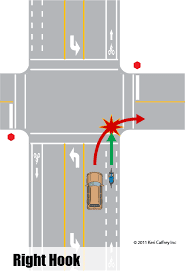
Protagonists point to studies that show how protected bike lanes are safer for urban bikers than either unprotected bike lanes or even bike boulevards.  Studies are generally in agreement on the issue of bike safety, at least for travel between intersections.  Intersections however remain problematic from a safety perspective and some of the studies reveal that intersections are actually more dangerous for a protected bike lane corridor, owing to higher vehicle speeds and higher vehicle volumes generally associated with protected bike lanes over bike boulevards.  The infamous 'right hook' move, that being vehicles turning right at an intersection crossing over the biker's line of travel, is particularly dangerous in a protected bike lane regime over that of a bike boulevard.  The problem stems from the tendency of drivers, not needing to be aware of bikes mid block, suddenly entering into conflict with them at the intersections.  Studies show drivers are much more aware of bikers around them on bike boulevards and they tend to drive accordingly, particularly if the bike boulevard vehicle speed and volume are properly attenuated.
But that has been the problem in Emeryville; there's been a lack of political will to implement the traffic calming measures for our bike boulevards that would make biking safer.  Regardless of the fact that bike boulevards are the law of the land in Emeryville for the last 20 years, City Hall has yet to actually try one.  Even still, the City Council is poised to remove them en masse in favor of the new paradigm.  Vice Mayor Medina put it bluntly; she told the Tattler she is ready to amend the Bike/Ped Plan to get rid of the boulevards in favor of the protected bike lanes if the pilot program shows public support.  That would represent a dramatic break from her colleagues who have steered clear of the controversial move of so amending the Plan, choosing instead over the years, to simply ignore it.
The infamous bike lane 'right hook'.
Not an issue on bike boulevards.

Developers will likely give support to the protected bike lane idea, especially the Sherwin Williams project that will dump thousands of car trips per day on our streets.  New renters will likely balk on high rents if it's too difficult for the car drivers to get to and from their homes that would be the case if the bike boulevards concept were to be implemented.  Protected bike lanes are agnostic on the issue of vehicle speed and volume and traffic could therefore be more atomized throughout our town rather than it bunching up on the arterial streets as it would in a bike boulevard scenario.

Left out of the new equation conspicuously however are pedestrians and people who value 'low and slow' quiet streets.  Removing bike boulevards in favor of protected bike lanes fails to accommodate their interests.  The higher vehicle speeds and heavier traffic on former bike boulevards morphed into protected bike lane streets are more dangerous to pedestrians at intersections and less aesthetic to lovers of quiet places.   Emeryville being Emeryville, even in the age of our new progressive City Council, it is possible these non-developer interests may ultimately not make the cut.


The Rise of Protected Bike Lanes in the U.S. from PlacesForBikes on Vimeo.
Protected Bike Lanes: The hippest thing since sliced bread.  Bike boulevards apparently are yesterday's news.
The video shows how popular protected bike lanes have become but makes a fatuous claim that vehicle speeds go down on streets with protected bike lanes.  Compared with streets with regular bike lanes, vehicle speeds are shown to be higher and compared with bike boulevards, even more so.  Bike boulevards are shown to bring down vehicle speeds the most of all bike corridor infrastructure solutions. 

Sunday, April 8, 2018

History of Bad Bike Policy Nets the City of Emeryville a Countdown Clock


Introducing:
The 53rd and 45th Street Bike Boulevards 
Countdown Clock

City Council: Be Warned


The policy makers at Emeryville City Hall have a way of forgetting about programs they don’t much care for and insofar as these programs are mandated by the General Plan and have a prescribed implementation timeline therein, the Tattler has always been there to gently remind them.  However, even our rigorous oversight has not been enough to coerce the decision makers to implement the Bike Plan, the part of the General Plan that City Hall historically has had the biggest aversion to.  
Owing to this intolerable situation, the Tattler now introduces the 53rd and 45th Street Bike Boulevards Countdown Clock.  The clock will be located at the bottom of the front page of the Tattler (phone users will have to load the web version to see it).  It will remain until the City places the traffic calming measures on these two streets the Bike Plan mandates.  Alternatively, the City Council could amend the Bike Plan to remove the traffic calming requirements for these two streets and then the Clock would be taken down.

Every Two Years
The 53rd and 45th Street Bike Boulevards Countdown Clock is set to run out to zero on September 14th, 2019 at 5:00 pm, the latest possible time the City has to implement the next required level of traffic calming measures placed on the two streets.  The clock began on September 14th, 2017 after the required official traffic count was completed when the City became aware that there is too much vehicle traffic on the two streets.  The City conducts the traffic counts on every Bike Boulevard every two years as the Plan stipulates and if an “overage” of traffic is found, the City is required to emplace traffic calming measures, after which a new countdown begins.


It is hoped the City Council will look to the Tattler 53rd and 45th Street Bike Boulevard Countdown Clock in place of their staff who has been negligent in reminding them of their duties regarding the Bike Plan.  Since the staff has opined that temporary traffic calming measures need to be emplaced for at least six months before a new traffic count can be considered reliable, the Council is reminded the clock only records the actual time when the measures need to be on the roadways and it doesn’t take into account any internal scheduling policies.  
The City needs to do its due diligence and make sure the clock doesn’t run out without the next traffic calming measures in place on 53rd and 45th Streets.  Additionally, the Clock will not be reset except insofar as duly prescribed Bike Plan traffic calming measures are implemented.  And warning to the elected officials: the Clock will help serve as the people’s accounting device at election time.

Sunday, April 24, 2016

Emeryville City Hall Staff Doesn't Understand Bike Boulevards

"Like a Squeezed Balloon..."

Emeryville's City Hall Staff Can't Imagine
Bike Boulevards

Analogy for Sisyphean Meaningless Work: 
Squeeze it here and the air goes over there;
you've accomplished nothing says Emeryville.
News Analysis/Opinion
Sometimes a single utterance gives away the whole game...
When a feature of a democratically vetted new polity is described by those entrusted with promulgating it as a flaw, you know there's a fundamental lack of understanding going on.
And that's what's happening behind the scenes at Emeryville City Hall right now.

Case in point: when recently interviewing the department heads management staff, the same curiously quoted axiom kept coming up: the idea of the futility of squeezing a balloon as a stand-in for meaningless work.  What these paid staffers are referring to is our Bike Plan and its provisions for building a network of bike boulevards in Emeryville.
Bike boulevards are corridors set aside primarily for bicycles and central to that endeavor is the requirement laid out in the Bike Plan to strictly limit the number of motor vehicles using these specially designated streets.  The Plan seeks to force cars from the bike boulevards over to regular streets for the safety of bicyclists.  This isn't a bug, it's a feature.
"If the idea is to atomize traffic in town, 
trying to keep an equal amount 
on all streets that the balloon 
analogy reinforces, then there's really 
no such thing as a bike boulevard". 

And yet our City staff can't seem to understand this basic principle, hence the oft repeated balloon analogy.  What they don't understand, they don't want.  At its core is a refusal to accept bike boulevards.  If the idea is to atomize traffic in town, trying to keep an equal amount on all streets that the balloon analogy reinforces, then there's really no such thing as a bike boulevard.  And viewing their actions trying to stop the Horton Street Bike Boulevard specifically over the last couple of years, it's safe to say we now know the philosophic underpinnings to their work: they can't even imagine a bike boulevard.

City Manager Carolyn Lehr
A fundamental lack of cognition:
"Like a squeezed balloon, the traffic
will just go elsewhere, you're
not solving anything" she said
of bike boulevards.
Who has spoken of squeezed balloons at City Hall?  The top brass; our City Manager Carolyn Lehr, our Director of Public Works Maurice Kaufman and also at least one underling.

We call on the Emeryville City staff to educate yourselves about our General Plan, our Bike Plan and Bike Boulevards.  The squeezed balloon image that you've been citing as reason for your dismissive demeanor is actually how it's supposed to work; we're supposed to squeeze traffic off the bike boulevards and onto regular streets.  Remember, it's bikes preferred, cars allowed on bike boulevards.  So stop trying to subvert that basic premise and get with the program.

Wednesday, September 10, 2014

City Calls For Community/Business Input on Horton Street Bike Boulevard

The City Council is soliciting opinions from the community and businesses on whether or how to implement the Pedestrian/Bicycle Plan with regards to the Horton Street Bike Boulevard:


Sunday, December 12, 2010

The Bike Boulevard Scam

Emeryville Subverts Safe Biking
Bike Boulevards Encourage Car Use

News Analysis
The last several years has brought a Bay Area renaissance of bicycling as a legitimate form of commuting, not just recreation. Central to this flowering has been the municipal legislation of transit corridors known as bicycle boulevards.  Cities around the region have been implementing networks of bike boulevards to help encourage bicycling.  Bike boulevards are meant to increase safety and to provide for the most direct routes to ease commuting for bicyclists.
In Emeryville however, bike boulevards are being used to enhance the ease of and encourage the use of automobiles at the expense of bicycling; precisely the opposite of the intent of these boulevards.


Emeryville started implementing a network of bike boulevards a few years ago by replacing planned or existing class 2 bike lanes.  This has been done by amending the Emeryville Bike/Pedestrian Plan.  So far there hasn't been any public outcry against this because most people perceive a bike boulevard as being better for bikes than a class 2 bike lane which is essentially a street with striped bike lanes; one for each direction.  In a normal town, the public would be correct; a bike boulevard IS superior but here in Emeryville bike boulevards are just a degradation of a class 2 bike lane to a class 3 bike route.  This is because Emeryville hasn't defined a bike boulevard as a quiet street, like our neighbors have.


Definitions:
  • Bike Boulevard- A street where cars are allowed but bicycles are preferred. The cars that are allowed must be attenuated as per speed and volume so as to encourage bike use and discourage car use. 
  • Class 1 Bike Path- A completely segregated path for bikes that is separated from cars by physical barriers. 
  • Class 2 Bike Lane- A street where bikes are segregated from the cars by use of a painted lane on the side of the street, usually one each side. 
  • Class 3 Bike Route- A street where bikers are given green way-finder signs. Bikes and cars share the street with no preference to one or the other. 

Without traffic calming: a Bike Boulevard is essentially no different than a Class 3 bike route, since bikers must share the road with unrestricted cars.

With traffic calming: it can be argued that Bike Boulevards are safer for biking than a Class 2 bike lane since the cars are few and moving slowly.


Emeryville Bike/Pedestrian Plan, adapted in 1998 proscribed a network of mostly Class 2 bike lanes throughout town to keep bikers safe from moving cars on the streets. The last few years has seen the removal of many of the striped lanes in favor of bike boulevards by the Transportation Committee. The committee, comprised of council members Nora Davis and Ken Bukowski has noted that the bike lanes constrict car use by removing parking spaces on streets that are too narrow to accommodate both lanes and parking. The original Bike/Pedestrian Committee was aware of this but it was determined that in in absence of effective traffic calming, it is important for safety to segregate the cars and the bikes on a few key streets.

In Berkeley, bike boulevards are seen as improvements for bike safety since cars are not permitted to travel faster than 25 mph and the number of cars is limited to no more than 3000 per day.  Berkeley monitors their bike boulevards to assure compliance.  In Emeryville, the council majority has said NO to any traffic calming of cars on our new bike boulevards, rendering them to the lowest level: Class 3.

The result of this quiet imposition of bike boulevards in our town over the last couple of years has been the lowering of bike safety and the raising of accommodation for cars.

A new Bike/Pedestrian Plan to supersede the old plan is being worked on at City Hall and will be complete by the summer of 2011.  The new plan will provide for a large network of bike boulevards but citizens already have something right now to assure safe biking: the existing Bike Plan and its network of Class 2 bike lanes.   Forces in town that want to accommodate more cars, the forces that have the council's ear, can be expected to intercede and make the new plan help their interests.  This will take the form of more bike boulevards with out any of the enforceable automobile restrictions that our neighbors have.  Residents that want bicycling to remain a viable form of transportation will have to make their voices heard if they expect to be able to safely ride a bike in Emeryville.


Class 1
The Bay Trail along the bay front is an
example of a Class 1 bike path


Class 2
A Class 2 bike lane is supposed to provide enough
 room next to the parked cars to prevent bicyclers
 from injury due to car doors opening
Class 3
A Class 3 bike route is a normal street
 except  for the green bike route signs
Bike Boulevard
A bike boulevard has street stencils
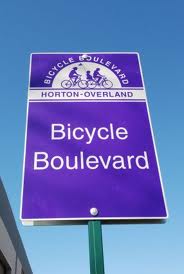
A Bike Boulevard also has
purple signs